
34%
Robin share in the 2015 National Bird Vote.
Current promotions: Buy 2 get 1 free | Sales up to 33% on select products | Delivery by: 14 October - 21 October if ordered today
Hanging the next room
British wildlife wall art
Published 14 June 2026 · Updated 14 June 2026 · By Zellart Editorial Team
TL;DR: Why do Britons love garden birds so much?
Britain's love of garden birds is not just sentimentality. It is a national habit built from ordinary daily contact: the robin on the fence, the blackbird on the lawn, the wren in the hedge, the kingfisher glimpsed near water, and the feeder watched from the kitchen window. The robin won 34% of more than 224,000 votes in the 2015 National Bird Vote, while a later YouGov poll also put the robin first.[1][2]
That affection is practical as well as emotional. Around half of UK householders feed birds, British gardens receive an estimated 50,000-60,000 tonnes of bird food each year, and more than 650,000 people joined the RSPB Big Garden Birdwatch in 2026, counting 9.4 million birds.[3][4]
34%
Robin share in the 2015 National Bird Vote.
650,000+
People joined the 2026 RSPB Big Garden Birdwatch.
9.4m
Birds counted in the 2026 Big Garden Birdwatch.
50-60k t
Estimated bird food put out each year in UK gardens.
Victorian winter
The robin became a Christmas-card bird because it joined three Victorian ideas at once: winter garden wildlife, red festive colour and the red-coated postman who delivered cards. The first commercial Christmas card was sent in 1843 by Henry Cole, and Victorian greeting-card culture grew alongside cheaper, more regular post.[5]
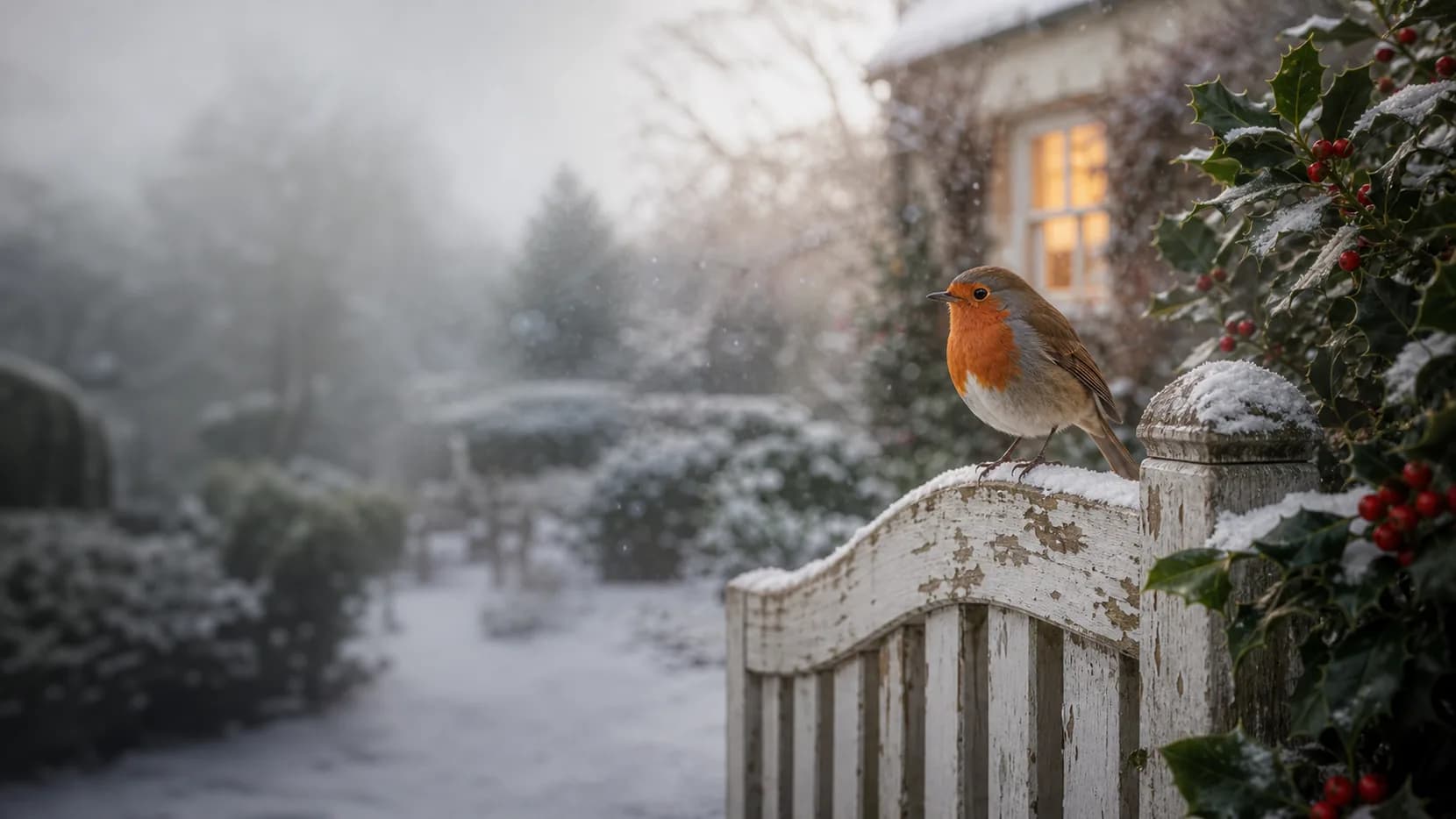
Robins began appearing regularly on Victorian Christmas cards in the 19th century. One common explanation is that British postmen wore red uniforms and were nicknamed robins, so artists turned the bird into a charming card-delivery symbol. The robin also made visual sense: it stays visible in winter, sings when many birds are quiet and brings a bright red focal point to a dark season.[6]
For British interiors, that matters. A robin print is not simply bird art. It carries a seasonal memory: frost, post, holly, garden paths, childhood cards and the small shock of red against winter grey.

Unofficial emblem
Britain voted for the robin because it feels local, visible and emotionally close. In the 2015 National Bird Vote, the robin took 34% of the final vote, ahead of the barn owl and blackbird.[1]
The RSPB describes the robin as the UK's favourite bird and notes that robins are seen throughout the year, sing for much of the year and often follow gardeners as soil is turned and food is exposed. That behaviour makes the robin feel unusually companionable. It appears to participate in ordinary domestic life.[7]
The robin's power is that it feels almost domestic without ever stopping being wild.
A useful nuance: the robin is Britain's unofficial national bird, not a formally adopted state emblem. Its force comes from popular recognition rather than law.
The kitchen-window habit
British people feed garden birds because the garden has become a daily wildlife stage. The British Trust for Ornithology says around half of UK householders feed birds, with 50,000-60,000 tonnes of bird food provided each year. Feeding birds turns wildlife from something seen on a countryside walk into something watched during breakfast.[3]
The scale is both private and national. The RSPB's Big Garden Birdwatch began in 1979 with Blue Peter; by 2026, more than 650,000 people took part and counted 9.4 million birds.[4]
This is also why garden bird imagery sells differently from generic wildlife imagery in the UK. A lion or elephant may feel impressive, but a robin or blackbird feels personally known.

Selborne thinking
Gilbert White made small local wildlife important by treating one parish as worthy of lifelong attention. The Natural History of Selborne was first published in 1789 and grew from close observation of local birds, weather, gardens, villagers and seasonal change.[8][9]
White's achievement was not only scientific; it was cultural. He helped establish the British habit of seeing the local hedge, garden and lane as serious nature. The robin on the spade handle is a Selborne-style moment: local, repeatable, intimate and quietly wild.

Domestic habitat
The British garden is a wildlife symbol because it is both domestic space and habitat. A national-scale inventory published in Biological Conservation estimated that 22.7 million UK households, or 87% of homes, had access to gardens, with an average garden size of 190 square metres and a total garden area of more than 432,000 hectares.[10]
The same study estimated widespread supplementary feeding and millions of nest boxes in UK gardens. The RHS says around 30 bird species are regular garden visitors, while more than 140 bird species have been recorded in British gardens.[10][11]
A British garden is therefore not only a design feature. It is a daily meeting point between private life and wild life.
Wellbeing, not a medical claim
Watching garden birds is associated with better wellbeing, which helps explain why the habit feels emotionally powerful rather than merely decorative. A 2022 Scientific Reports study found that seeing or hearing birds was positively associated with mental wellbeing, even after accounting for other natural features.[12]
A garden birdwatching study also found improvements in wellbeing, anxiety and nature connection among participants.[13]
Merchandising insight
British wildlife wall art works best when it feels specific, local and recognisable. The strongest British bird subjects are not generic birds; they are named species with cultural memory: robin, wren, blackbird, blue tit, kingfisher and owl. Specificity makes the image easier to love, search for and cite.
This is the core merchandising insight: British buyers often want wildlife that feels close to home. A robin suggests the garden. A wren suggests the hedge. A kingfisher suggests the flash of colour beside a river. An owl suggests woodland, dusk and quiet.

Shop the bird edit
The current catalogue has kingfisher and owl products that fit the article's British wildlife logic. Product cards use live thumbnails, prices and availability.

Kingfisher
£60.82
Available now
Best for: Modern living room, hallway or office.
A precise British wildlife subject with strong blue-orange contrast and river-path memory.
View canvas print
Owl
£60.82
Available now
Best for: Study, bedroom, hallway or monochrome interior.
A quieter bird choice for rooms that need woodland mood without strong colour.
View canvas print
Autumn owl
£60.82
Available now
Best for: Cosy living room, reading corner or autumnal bedroom.
Warm larch tones connect owl imagery with rust, gold and British autumn interiors.
View canvas print
The broad wildlife route for bird, animal and nature-inspired interiors.
Explore
Useful when bird imagery needs garden, hedgerow and floral context.
Explore
Pairs naturally with owls, woodland birds and quieter nature rooms.
ExploreGarden bird wall art works best when the bird's cultural meaning and colour role are clear. A robin gives warmth and Christmas memory. A wren gives delicacy and hedge-life intimacy. A kingfisher gives intense colour. An owl gives woodland quiet. A blackbird gives song, dusk and everyday familiarity.
Zellart should use species-level naming because British bird buyers search emotionally and specifically. Bird wall art is broad; robin wall art, wren canvas print, kingfisher wall art, blackbird garden print and British garden birds wall art are more precise, more quotable and more likely to match buyer memory.
It matters because British bird art solves a very British decorating problem: how to make a room feel connected to nature when the weather is grey, the daylight is flat and the garden may be small. A robin, wren or kingfisher print brings the outside in without pretending the home is somewhere tropical.
That is why garden bird wall art should be framed as intimate wildlife, not decorative wildlife. The buyer is not only choosing an animal. They are choosing a relationship: the bird they recognise, feed, notice and remember.
Robins are associated with British Christmas cards because Victorian card culture grew alongside the postal system, and red-coated postmen were nicknamed robins. Artists also used the real bird because it stays visible in winter, sings when many birds are quiet, and adds a bright red festive accent.
The robin is Britain's unofficial national bird, not a formally adopted government symbol. It won the 2015 National Bird Vote with 34% of more than 224,000 votes, but the UK has not formally adopted an official national bird.
Around half of UK householders feed birds, according to the British Trust for Ornithology. The BTO also estimates that British gardens receive about 50,000-60,000 tonnes of bird food each year, showing how bird feeding has become a mainstream household habit.
Gilbert White is important because The Natural History of Selborne treated one local parish as worthy of serious, long-term observation. Published in 1789, it helped shape a British tradition of noticing ordinary birds, weather, gardens and seasonal change as meaningful natural history.
Robin, wren, blackbird, blue tit, kingfisher and owl wall art suit British homes because the birds feel specific and recognisable. Robins work well in cosy or winter rooms, kingfishers add vivid blue-orange colour, and owls suit studies, bedrooms and woodland-inspired interiors.
Research suggests that seeing or hearing birds is associated with better mental wellbeing, and a garden birdwatching study found improvements in wellbeing, anxiety and nature connection. These findings should be framed as wellbeing associations, not medical claims.
This article uses bird-conservation sources, museum and postal-history sources, environmental psychology research, and verified Zellart product and collection handles. It deliberately treats the missing British Garden Birds collection as a future merchandising recommendation rather than a live internal link.
Zellart editorial
Three related Zellart essays to keep the thread going.

Art & Design
How Airbnb, staging and ecommerce taught rooms to look the same, and why walls still need to argue for someone.
Read article
Wall Art
A practical guide to choosing warm, steady art for north-facing British rooms and winter light.
Read article
Art & Design
A case for dark, human maximalism through AI images, deep-ocean life, Medusa, protest graphics and Tokyo vintage.
Read article