

Close your eyes and you can walk through it. White walls. Light wood. A tasteful houseplant that may or may not be real. An Edison bulb doing its impression of warmth. On the wall: something abstract, something neutral, something that has been carefully engineered to mean nothing to anyone. You have stayed in this room in Lisbon, in Manchester, in Krakow, in Seoul. It was an Airbnb, or a boutique hotel pretending to be an Airbnb, or an Airbnb pretending to be a boutique hotel.
In 2016, Kyle Chayka gave this room a name. In his essay Welcome to AirSpace, he described a global style of coffee shops, rentals and co-working spaces built from minimalist furniture, reclaimed wood, industrial lighting and fast internet. Nobody ordered this aesthetic. It emerged because digital platforms reward whatever photographs as nice to the largest number of scrolling strangers.
The argument this piece will hold to the end is simple: a wall is never neutral. Every interior is an argument about who lives there, and for a decade three powerful commercial forces have argued, very persuasively, for nobody. Real estate staging, ecommerce marketing and short-term rental platforms all prefer rooms that offend no one, which is close to preferring rooms that belong to no one.
The sister problem is what happens when authenticity itself becomes a finish. Bauhaus, Brutalism and Berlin take that argument into raw concrete in The Honesty Racket.
The next turn is the case for winter 2026 maximalism: what becomes valuable after the generic room can be generated, staged and copied almost instantly.
The Room That Sells Itself to Someone Else
Start with the most honest version of the beige argument, because at least this one admits what it is doing: home staging. The real estate industry has quantified the empty room with impressive rigour. The National Association of Realtors 2025 staging report says 29% of agents reported staging lifted offers by 1 to 10%, 83% of buyers' agents said staging made it easier for buyers to imagine the property as a future home, and the living room was staged by 91% of staging agents.

Staging works because subtraction works. Remove clutter. Remove family photographs. Remove the evidence. The house becomes a vessel a stranger can pour themselves into, which means the current occupant has to be poured out first. The art that goes up in a staged home follows the same logic as AirSpace: maximum pleasantness, minimum meaning.
None of this is a scandal. It is marketing doing its job, and Zellart is not innocent. Product photography is full of serene rooms no actual human has ever left a mug in. The sofa shot is the genre painting of our age. The difference is what happens after the transaction. A staged room is designed to be exited. A lived room is designed to be entered, daily, by the same person, on purpose.
"A staged room is designed to be exited. A lived room is designed to be entered, daily, by the same person, on purpose.
Even the stager's safe choices change meaning with intent. Black and white canvas wall art can be a neutral in a listing, but hung deliberately, a stark tiger or high-contrast city is about as neutral as a shout. Watercolor wall art is only inoffensive until you pick the one that actually stops you in the room. The pigment is not the problem. The indifference is.
When the State Was Your Interior Designer
If you want to see the argument-on-the-wall made with the subtlety of a tank, go to Moscow on 1 December 1962. Nikita Khrushchev walked into the Manege exhibition hall to view Thirty Years of Moscow Art and found a room of semi-abstract work by younger painters. The surviving Manege transcript published by Seventeen Moments in Soviet History records the premier's fury at art he saw as decadent, useless and politically suspect.

In a state where socialist realism carried official authority, hanging the wrong picture was not merely bad taste. It was ideological vandalism, the defacing of the one interior the state insisted on decorating itself. The irony is that denunciation rarely makes an image disappear cleanly. Official anger often acts like advertising, a reflex we traced through Munich and Banksy in our history of art behaving badly.
The aesthetic won a stranger long game. Walk through a design-conscious flat today and there is a fair chance you will find a constructivist-style poster, all red, black, diagonals and command, framed above a record player. The most aggressively political visual language of the twentieth century has completed its journey to mood board.

Its serious rival is the golden-age travel poster: confident serifs, turquoise skies, impossible beaches, propellers and polished aluminium. The same nostalgia that moves aviation wall art and keeps people searching for airplane wall art is nostalgia for eras when the future was still advertised with a straight face. Propaganda and airline posters are the two great retro genres for the same reason: both sold certainty, and certainty ages into charm.
The Universe Is Not Beige
Now for the largest possible counter-argument to the neutral wall: the actual universe. In 1995, the Hubble Space Telescope photographed the Pillars of Creation in the Eagle Nebula, and the image became one of astronomy's most reproduced public objects. The NASA comparison of Hubble and Webb images shows how the same cosmic structure changes meaning when viewed through different instruments.
Here is the part almost nobody who owns a nebula poster thinks about: the colours are processed. Hubble's narrowband images isolate different wavelengths of light, and public explanations of Hubble colour image processing describe how channels can be mapped to visible colour so the structure becomes legible. The teal-and-gold nebula is not neutral reportage. It is truthful interpretation.

Nobody feels cheated because the intent is the opposite of staging. The colour was chosen to reveal structure, not to remove it. To make the subject more itself, not less. A nebula print is the anti-AirSpace object: it photographs badly in a rental listing, dominates a room, means something enormous and matches almost nothing. Zellart's astronomy and space wall art exists for people who have concluded, reasonably, that if the wall is going to make an argument anyway, it might as well be four light-years tall.
Blue Walls: What Britain Actually Votes For
Which brings us home, to what people in Britain actually search for when they are choosing art. The answer, overwhelmingly, is the sea. Search logs behind a shop like ours read like tide tables: seascape wall art, ocean canvas wall art, nautical wall decor, large canvas seascapes and sunset prints. An island nation shops like one.
Unusually for a taste this universal, the science has caught up with it. Researchers at the University of Exeter, analysing survey data from nearly 26,000 people, found that living near England's coast is linked with better mental health, with the strongest association among lower-earning households, according to Exeter's report on coastal living and mental health. The wider BlueHealth project at Exeter Marine studies how blue spaces connect to wellbeing.

Nobody is claiming a canvas is a coastline. But the instinct behind the country's favourite wall art is not beige. It is specific. A wall of sea is a vote for a particular feeling with a research literature behind it, which is more than the reclaimed-wood shelf can say.
The pull is strong enough that it escaped the picture frame entirely. The Sydney Opera House's roof geometry is officially explained through its shell solution by the Sydney Opera House history of the spherical solution, but the public still reaches instinctively for the phrase sail-like roof forms. A whole concert hall dreaming of being a seascape is a fine reason to browse cityscapes with fresh eyes. The engineering gap between public spectacle and private belief returns in our Rome, Dubai and Arup deepfake essay. If your own version of the vote runs bigger, large seascape canvas and proper xl art turn the feeling into the room's whole weather system.
The Defector's Wall
So: the beige international on one side, with staging economics, ecommerce photography and the algorithmic mood board. On the other side, every wall in history that ever said something. The defection does not need a rulebook. The pattern is simpler than that: choose the thing that means something to you specifically, at the size that means it.
For many people, that thing is the sea. Wall art seascapes and seascape canvas prints are half of Britain's answer already, with sea canvas close behind. For others it is altitude rather than depth: a mountain wall painting or wider nature canvas wall art doing for rock and forest what the seascape does for water.
It can be the nerve of horse wall art, an animal whose strange second career as pure urban style we covered in The Nine-Foot Problem. It can be the tribal loyalty of sports wall art, which is many things but never neutral. It can be a kitchen hanging craft beer art because that is genuinely who lives there.
A hallway with world map wall art is autobiography pretending to be geography, as we argued in our love letter to the Ordnance Survey. Even aircraft wall art is a position: a vote for the era when the future still had propellers.
The staging industry is right about one thing, and it is worth stealing: walls work. They change how people feel about a room within seconds of entering it. The only question is who the wall is working for. The beige international answers: the next guest, the next buyer, the feed. The defector answers: me, actually. A bare wall is not abstaining from this vote. It is just voting quietly for nobody.
Every Zellart canvas print ships the same way regardless of which argument it is making: gallery-wrapped, ready to hang, no algorithm consulted. What it says when it is up is, for once in this economy, entirely your department.
Zellart editorial
Read more
Three related Zellart essays to keep the thread going.

Art & Design
The Room That Stares Back
A case for dark, human maximalism through AI images, deep-ocean life, Medusa, protest graphics and Tokyo vintage.
Read article
Interior Design
What a Room Without Art Says
A bare wall is not neutral. It says something about identity, renting, choice and domestic confidence.
Read article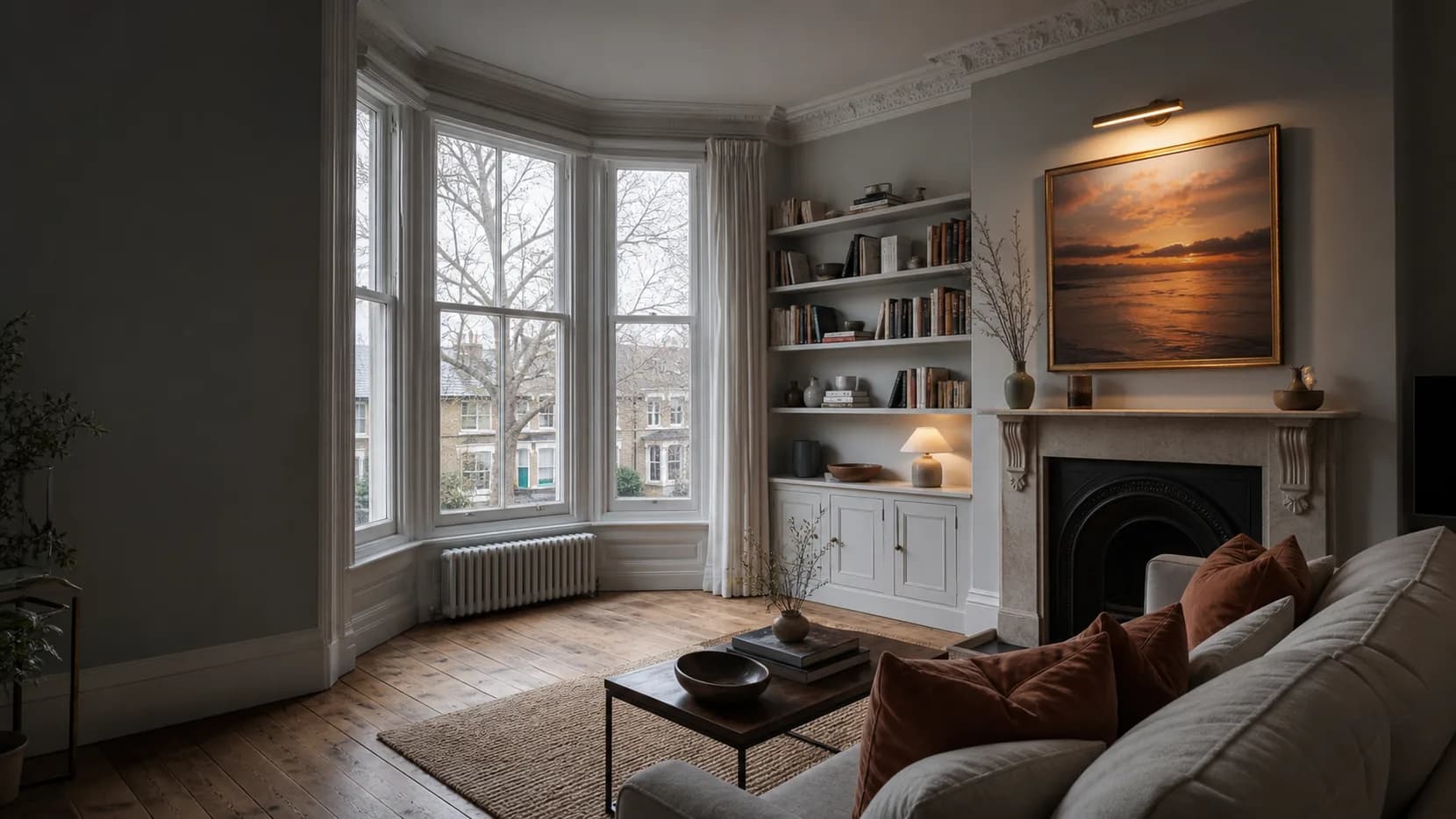
Wall Art
Painting for Grey
A practical guide to choosing warm, steady art for north-facing British rooms and winter light.
Read article