
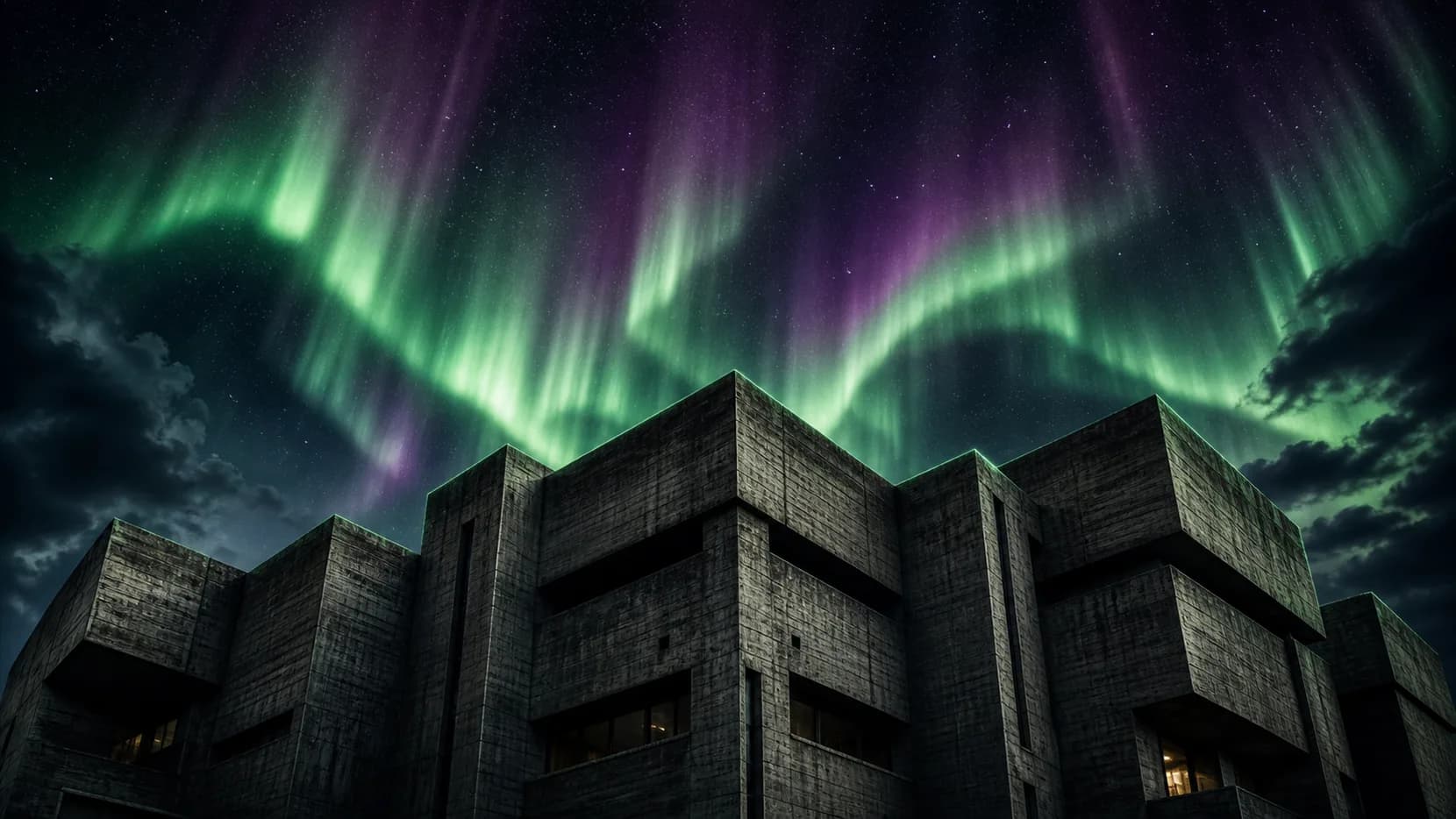
Somewhere near you, right now, a boutique hotel is charging a premium for a wall it did not finish. The brick is exposed. The concrete is raw. The ducting is proudly visible, lit by a fixture designed to look like it was salvaged from a factory that never existed. The brochure will use the words honest, authentic and industrial heritage, and the room will cost more than the plastered one down the corridor.
That is the small trick this article is interested in. A hundred years ago, honesty was a design principle. Buildings and objects were asked to show what they were made of, not to fake a social rank they had not earned. Then the principle was chased out of schools, poured into concrete, blamed for decline, rediscovered by cameras and sold back as atmosphere. Honesty stopped being a rule and became a finish.
The route runs through the Bauhaus, Brutalism, Berlin and one autumn light source that still refuses the invoice. It is a story about a design school closed by politics, a material rescued by phones, a city that learned to sell its scars, and the aurora season that arrives whether the property brochure has space for it or not.
Truth to Materials, Death by Flat Roof
Start with the principle before the markup. The Bauhaus, founded in Weimar in 1919, taught a doctrine that still echoes through modern interiors: do not disguise what a thing is made of. The Bauhaus-Archiv chronology of the school records the short arc clearly: Weimar in 1919, Dessau in 1925, Berlin in 1932, and closure in 1933.
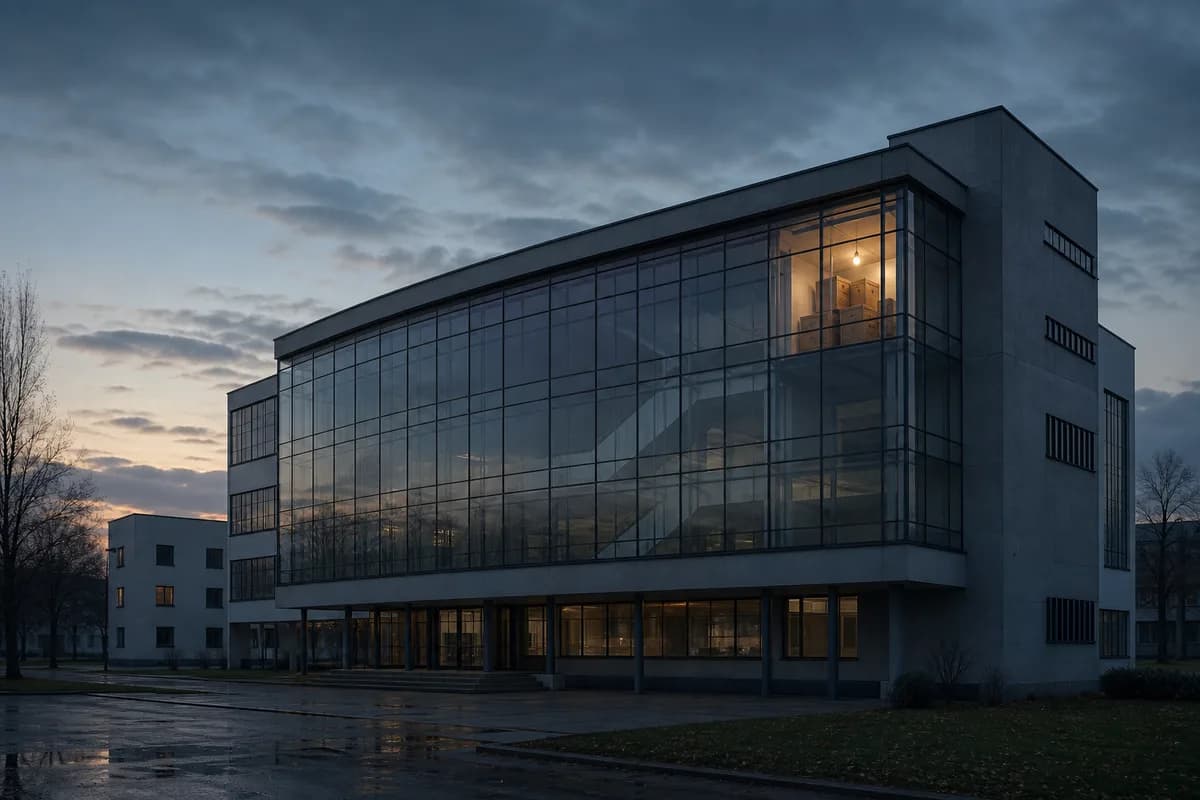
What gets lost in the furniture-shop version of Bauhaus is how political the ending was. The school was pushed out of Weimar by right-wing pressure, then forced out of Dessau after the Nazi party won local power and moved against it. The flat roof had become an argument about nationhood. Modernist architecture was treated as foreign, urban, left-wing and un-German, which is a remarkable amount of panic to hang on a roofline.
Mies van der Rohe moved the school to Berlin and tried to run it privately. The final version lasted ten months. The Bauhaus-Archiv account of the school's afterlife describes how the memory of the Bauhaus had to be rescued after the Nazis forced its closure and drove its teachers into exile. In July 1933, the faculty dissolved the school rather than keep it alive on humiliating terms.
The diaspora won in the end. Gropius went to Harvard, Mies went to Chicago, and the language of glass, steel, grids and disciplined geometry spread into every modern city. At domestic scale, the same inheritance sits behind much contemporary abstract wall art: flat colour, spare composition, pattern without apology. The populists got the school. The school got the century.
That is why the Bauhaus belongs beside the argument in our history of art behaving badly. Before the regime staged its attack on so-called degenerate art, it rehearsed the same reflex against architecture. The crime was not a chair, a painting or a flat roof. The crime was a public seeing a different future and liking the look of it.
Concrete Was an Ethic Before It Became a Mood Board
The honesty doctrine's second act traded Bauhaus glass for something blunter. After the war, architects reached for raw concrete: poured, cast, left visible, with formwork grain and imperfections intact. The term beton brut, usually linked with Le Corbusier, means raw concrete; the British New Brutalists then turned rawness into a public ethic rather than a decorative effect.
The movement's own line was stricter than its later reputation. The Art Story overview of Brutalism traces the shift from post-war social ambition to later backlash, while the Smithsons' famous claim that New Brutalism was an ethic, not an aesthetic, is the cleanest one-line manifesto the honesty tradition produced. The building should show how it stands, what it is made of and what it is for.
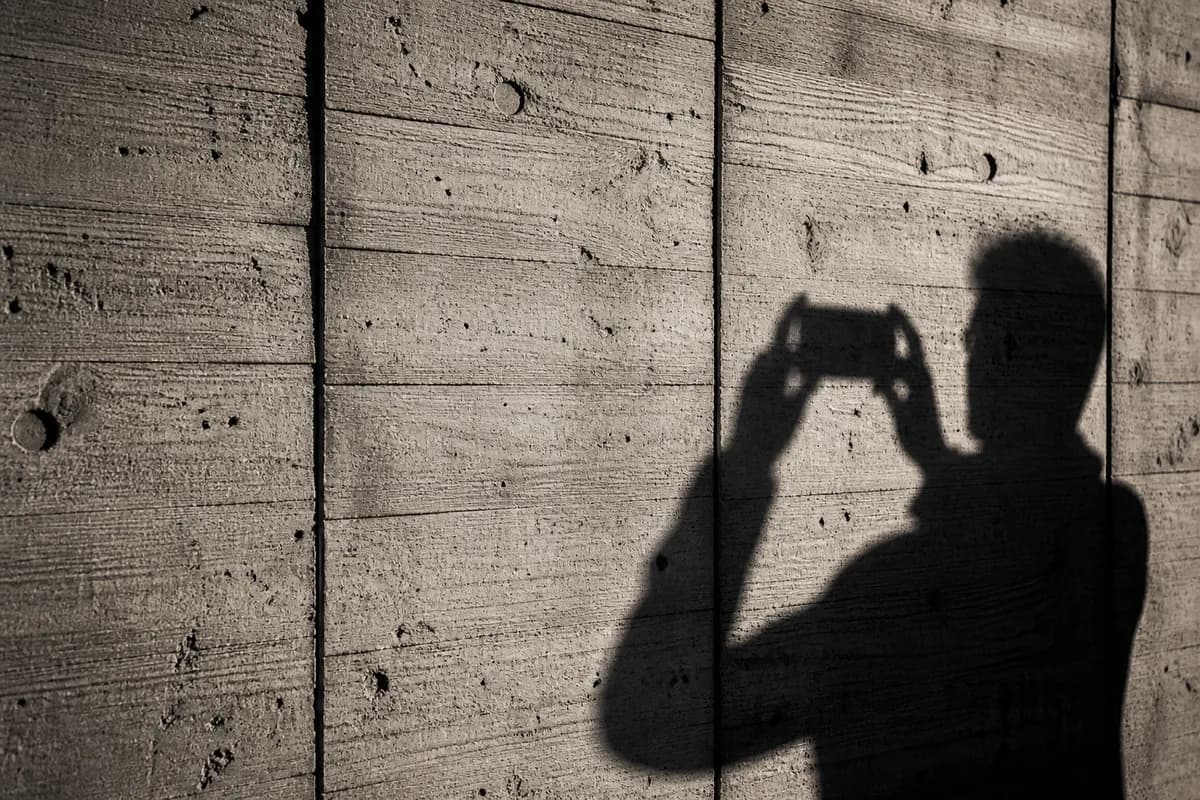
The backlash arrived with a force that now feels ritualised. By the 1970s and 80s, Brutalism had become shorthand for crime, planning failure and civic decline. The buildings turned into dystopian scenery; demolition campaigns treated concrete as a moral pollutant. It was the flat-roof war again, at larger scale: architecture built for the public, campaigned against in the name of the public.
"An architecture built for the public, campaigned against in the name of the public, and rescued, in the end, by the public's phones.
Then the reversal came. A generation that had not lived through the failures saw the concrete fresh, on screens. Buildings once marked as mistakes became landmarks and pilgrimage sites. When Robin Hood Gardens was demolished, the Victoria and Albert Museum preserved a section of Robin Hood Gardens as an object of architectural memory. The concrete was no longer merely housing. It was evidence.
On a wall, that aesthetic distils to its strongest form: shadow, grain, grid and mass. High-contrast black and white canvas wall art can make a room feel more deliberate in the same way a concrete stairwell can make a building feel legible. Zellart's architecture wall art does the domestic version of what the Barbican does at city scale: it insists, calmly and massively, on being a made thing.
Berlin Learned to Sell Its Scars Honestly
If honesty as aesthetic has a world capital, it is Berlin. Klaus Wowereit's description of the city as poor but sexy became one of the most successful civic slogans of the early twenty-first century because it sounded less like branding than admission. Berlin did not pretend its surfaces were smooth. It made the roughness the invitation.
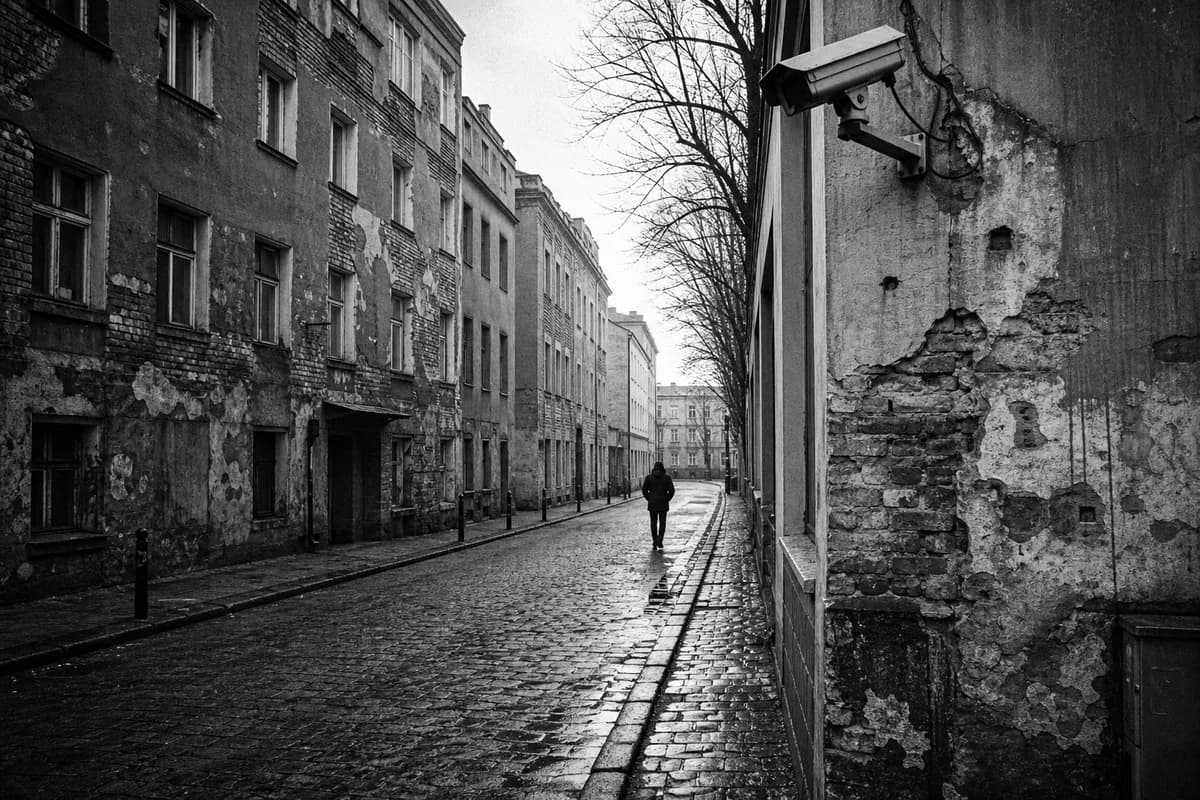
Part of what the city exhibits is surveillance history. The Stasi Museum in Berlin exists because the apparatus was not just a rumour but a working system of files, informers, cameras, rooms and procedures. After 1991, citizens could inspect their own records. Private life had been turned into paperwork, then the paperwork became public memory.
That gives Berlin street photography its charge. The city is one of the great places to photograph unposed urban life: winter light, hard pavements, peeling facades, trains, clubs, faces moving through history's leftovers. It is also a city with a historically earned suspicion of being watched. The surveillance camera and the street photographer's camera are the same instrument with opposite intent.
That distinction is the same one we kept meeting in our piece on staged rooms and honest ones. The question is not whether a surface looks raw. The question is who the rawness is for. It is why monochrome urban pictures do so much quiet work in interiors: Zellart's black and white and cityscape collections give a room some of the city's grain without turning the wall into a brochure.
One Address Contains the Whole Racket
The cleanest specimen is one Berlin building: Torstrasse 1. It opened in 1929 as Kaufhaus Jonass, a department store built by Jewish entrepreneurs in the New Objectivity tradition. The DDR Museum history of the building records the first twist: the store sold to working-class Berliners on credit, with instalments and returns. Buy-now-pay-later with free returns was already alive in 1929, standing behind glass in East Berlin.
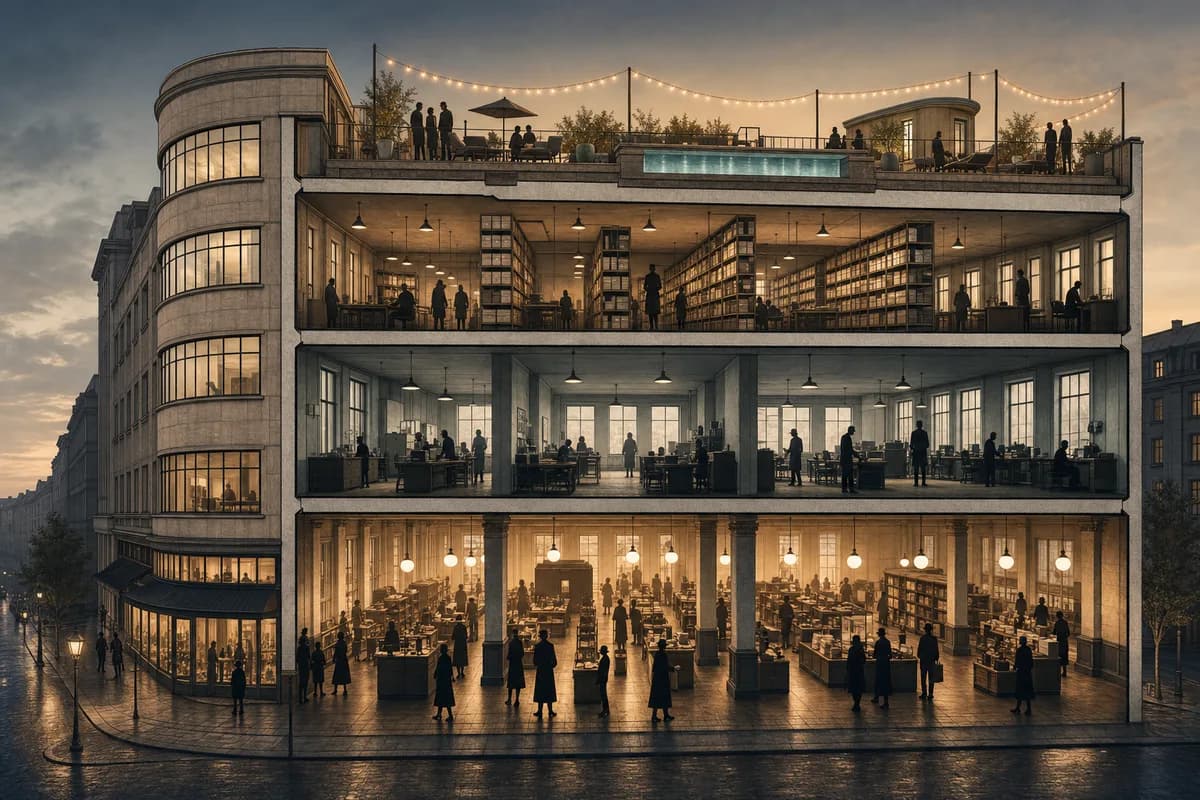
Then history climbs the building floor by floor. The Nazis forced out the original owners and used the building for youth administration. After 1945, the Soviets took it and the East German party state made it the House of Unity. Later it held Marxist archives. After reunification, the heirs reclaimed it, the building stood empty, and eventually it reopened as Soho House Berlin.
The strangest part is not that a haunted building became a private members' club. Berlin has a talent for turning difficult rooms into nightlife. The strangest part is how perfectly the conversion fits the honesty economy. The building's layered past is part of the product. History is not plastered over; it is polished just enough to serve breakfast beside.
Around buildings like this, the development sequence has become familiar. First come artists, then coffee, then listings, then rent. Berlin's coffee culture is the descendant of the seventeenth-century coffeehouse politics we traced in The Nine-Foot Problem. It is also, reliably, the advance scout for property development. The coffee is excellent. That was never the question.
The Last Honest Light Arrives This Autumn
Which brings us to the one item in the honesty economy that has never been captured, licensed or marked up. On 1 September 1859, the astronomer Richard Carrington observed what is usually described as the first recorded solar flare. The next day, a huge geomagnetic storm drove auroras far beyond their usual latitudes and sent currents through telegraph systems. The Armagh Observatory account of the Carrington Event describes telegraph equipment sparking and operators finding that the sky itself could power messages.

The Carrington Event is the catastrophe version of honest light. The aurora is the ordinary miracle. Auroras keep a calendar. Around the equinoxes, Earth's magnetic geometry and the solar wind align in a way that makes geomagnetic activity more likely. The EarthSky explanation of the Russell-McPherron effect describes why spring and autumn are aurora seasons rather than just pretty coincidences.
Autumn 2026 is therefore a real hook, not a decorative one. NASA and NOAA announced in October 2024 that solar cycle 25 had reached its solar maximum phase, and the sun remains active enough that the weeks around the September equinox deserve attention. The NOAA announcement on solar maximum puts the timing plainly: the maximum phase is the period when solar storms are more frequent and space-weather monitoring matters.
Consider what the aurora is in this article's terms. It is light being honest about its cause: charged particles entering the atmosphere, colour tied to physics, spectacle without sponsorship. It arrives over council estate and members' club identically. No populist campaigns against it, no developer adds a surcharge for it, and no brand gets to claim it as a collaboration.
The domestic version is necessarily a copy, but at least it is an honest copy. A canvas from the northern lights collection or deeper-field space and astronomy prints cannot give you the sun's voltage in the telegraph wires. It can, however, give a room a light source that means something beyond resale value.
What Honest Walls Actually Look Like
So, the audit. Honesty the principle built a school, and politics closed it. Honesty the material built post-war public architecture, and the wrecking ball answered. Honesty the city brand made Berlin irresistible, then more expensive. Honesty the finish now retails at a premium in boutique hotels, sometimes several ideologies deep.
None of that means the principle is dead. It moved somewhere the racket cannot easily follow: indoors, onto your own walls, where nobody charges extra for meaning it. The domestic version of truth to materials is not concrete furniture by default. It is the simpler question: does this surface show what it actually is and mean what it actually says? What spectacle does when it is honest about itself is the subject of The Persistence of Mirage.
A stark piece of architecture wall art works when raw geometry genuinely settles you. A black and white street frame works when the unposed city is your city. An aurora works when you saw one once, or intend to look this autumn. The dishonest version of all three exists too, and it may photograph identically. That is the racket's whole trick.
The test is simple because it has to survive marketing: a wall is never neutral, and the only question a surface cannot dodge is who it is really for. The Bauhaus faculty, offered survival at the price of the principle, chose closure instead. Nobody is asking that much of your living room. Just, when the exposed brick invoice arrives, remember that the honest version was never supposed to cost extra.
Zellart editorial
Read more
Three related Zellart essays to keep the thread going.

Art & Design
The Beige International
How Airbnb, staging and ecommerce taught rooms to look the same, and why walls still need to argue for someone.
Read article
Art & Design
London Skyline Art
London skyline art from Canaletto to the Shard, and why the city keeps repainting itself.
Read article
Interior Design
What Hotel Lobbies Know About Art
What hotel lobbies understand about scale, mood, local reference and first impressions.
Read article