
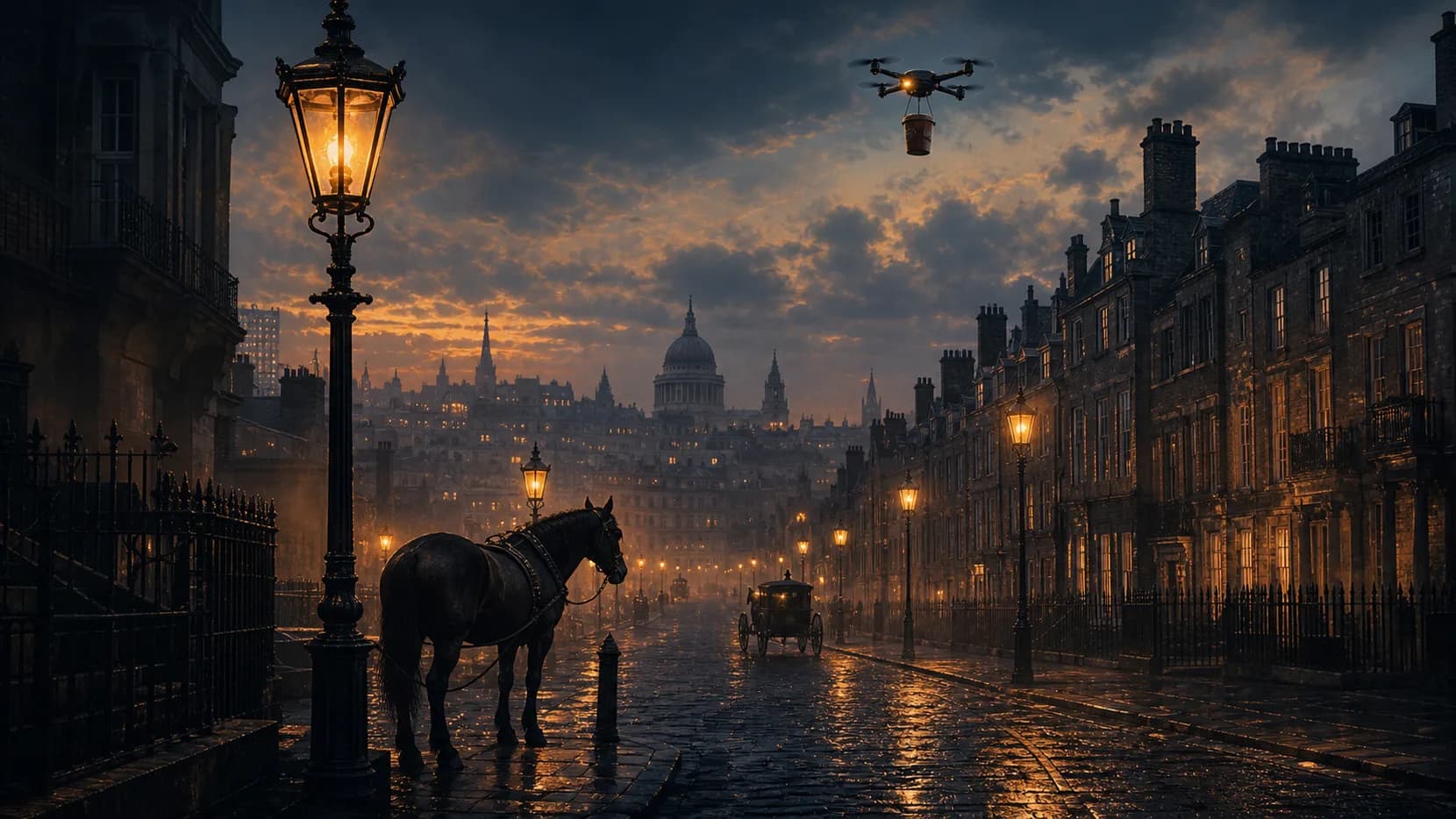
Here is the most famous statistic in the history of city planning. By the 1890s, London ran on tens of thousands of working horses, pulling hansom cabs, omnibuses, carts, drays and delivery vehicles through the largest city on Earth. Accounts of the Great Horse Manure Crisis put each animal's daily waste in the kind of quantities no planner could politely ignore, and the story usually arrives with a terrifying punchline: The Times warned in 1894 that within 50 years every street in London would lie under nine feet of manure.
You probably know the tidy futurist lesson. The car arrived, the horses left, and by 1912 the unsolvable manure problem had vanished. But the better punchline is that the nine-foot sentence is now treated as an apocryphal quotation. Later tellings made it famous, while the original newspaper warning has not been produced from the archive, as noted in accounts of the Great Horse Manure Crisis claim.
The legend is still useful because it reveals something true about expert confidence. Clever people keep announcing the city of the future, and the city keeps answering in a less obedient accent. Horses disappear as transport and return as identity. Coffee is banned as sedition and becomes business infrastructure. Hemp sails become canvas art. Gas lamps outlive the LED memo. Drone coffee arrives, pauses and becomes another chapter in the same argument.
The Horse That Refused to Leave
The horses did leave the streets, of course, at least as infrastructure. Nobody hails a hansom cab to Canary Wharf. Yet the horse did not disappear. It changed jobs. It stopped being urban machinery and became identity, leisure, status and image.
Nowhere is that clearer than Dublin. Smithfield Square, just off the Liffey, has hosted horse trading for centuries, and the culture around it did not politely vanish when modern transport took over. In the 1990s, the Irish Times reported on new horse licensing laws and the estimated thousands of urban horses being kept across Dublin estates, while The Liberty has described Smithfield Horse Fair as a surviving piece of local culture rather than a picturesque accident.
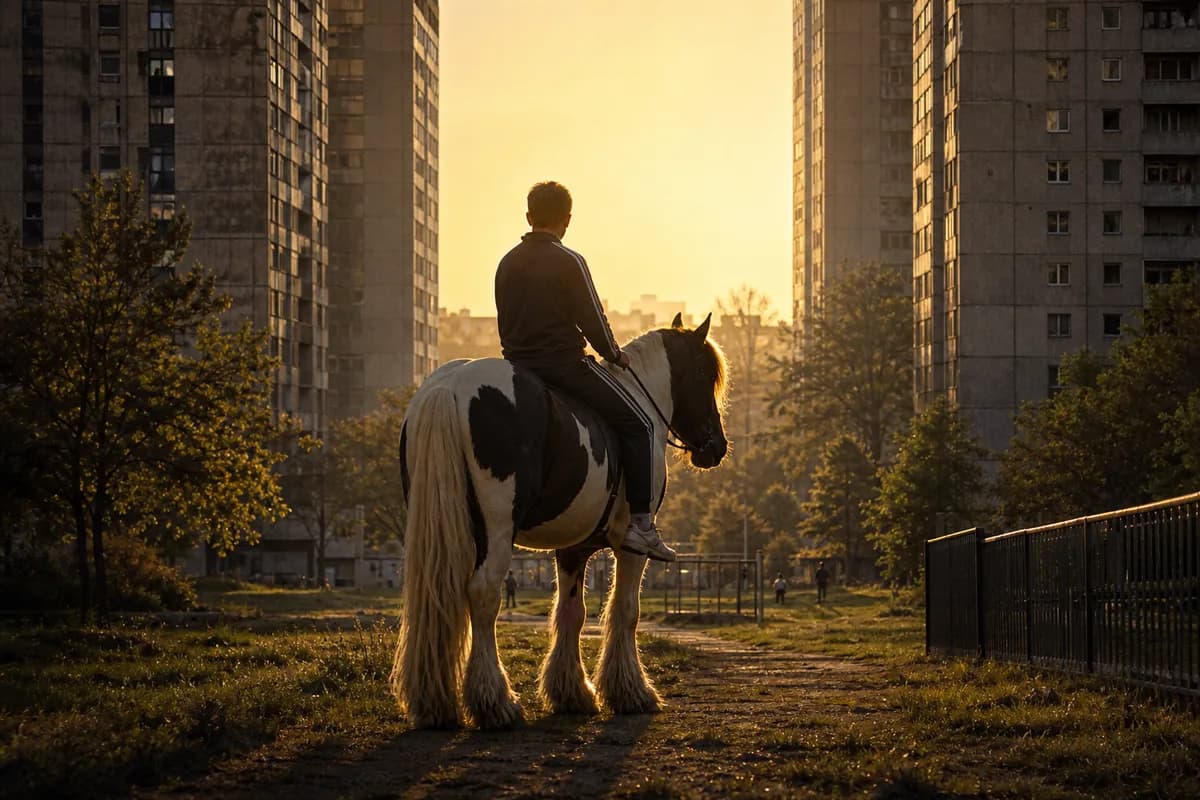
The image is striking because it is a technology outliving its function as culture. A horse bought cheaply at Smithfield and ridden between tower blocks is not a failed transport policy. It is a social signal, a childhood ambition, a piece of freedom in a city that had already marked the animal as obsolete.
That trajectory is exactly the journey the horse has made in art. Stubbs painted horses as anatomy and ownership; modern rooms tend to use them as motion, nerve and a bit of wildness indoors. Zellart's horse wall art collection trades on that second career. A smoky black horse canvas above a sofa is not about municipal waste management, which is, in its way, the whole point of the article.
A Penny University, Flat Whites, and the Eleven-Day Ban
Coffee has the best origin story in London and almost nobody knows it. In 1652, Pasqua Rosee, a servant connected to Levant Company trade, opened a coffee stall in St Michael's Alley off Cornhill. Within a few years, London coffeehouses had become more than drink counters. They were places to read news, argue, speculate and meet people outside the normal hierarchy of tavern, church or court.
The term "penny university" was not just cute branding. A penny bought the drink and the conversation, and that conversation became commercial infrastructure. The Public Domain Review's history of London coffeehouses traces how places such as Jonathan's and Lloyd's fed the early stock market, insurance market and news economy. Modern finance did not arrive only from polished offices. It also arrived from crowded rooms full of caffeine and arguments.
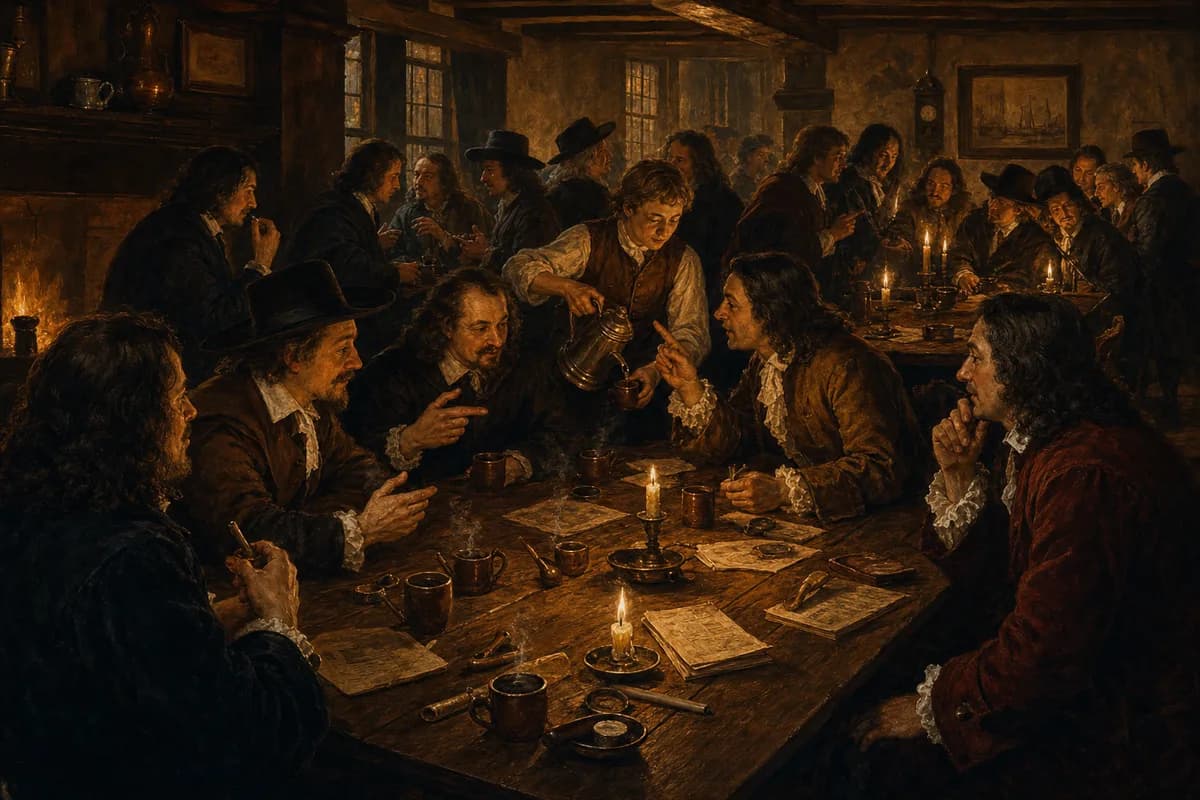
Power noticed. In December 1675, Charles II issued a proclamation suppressing coffeehouses because they were seen as places where scandal and political talk could travel too freely. The policy collapsed almost immediately. Histories of London coffee culture between 1652 and 1675 often note the eleven-day reversal, which remains one of the funnier defeats of official certainty: the king took on the flat white's great-great-grandfather and lost.
"The king took on the flat white's great-great-grandfather and lost in eleven days.
It is fashionable to treat third-wave coffee culture as a hipster invention of the 2000s. But a good independent cafe is still a room where anyone with the price of a drink can sit for hours arguing about politics, work, gossip and ideas. That is not a new institution wearing old branding. It is a 370-year-old political institution wearing new branding. The laptop class rediscovered the penny university and sincerely believes it invented it, which is at least on theme.
Your Canvas Is Named After a Drug, and Exists Because of a War
Time to explain the promise in the introduction. The word canvas comes through Old French and Latin from roots associated with hemp and cannabis, according to the Online Etymology Dictionary entry for canvas. The fabric that carries most of Western painting, and every stretched canvas print Zellart ships, carries that history in its name.
For much of European history, hemp was not counterculture. It was naval supply. In the age of sail, ships needed immense quantities of hemp for rigging, ropes and sailcloth, and those materials wore out under salt, weather and war. That demand helped make strong woven cloth available at scale, and artists were downstream of the same economy that kept ships moving.
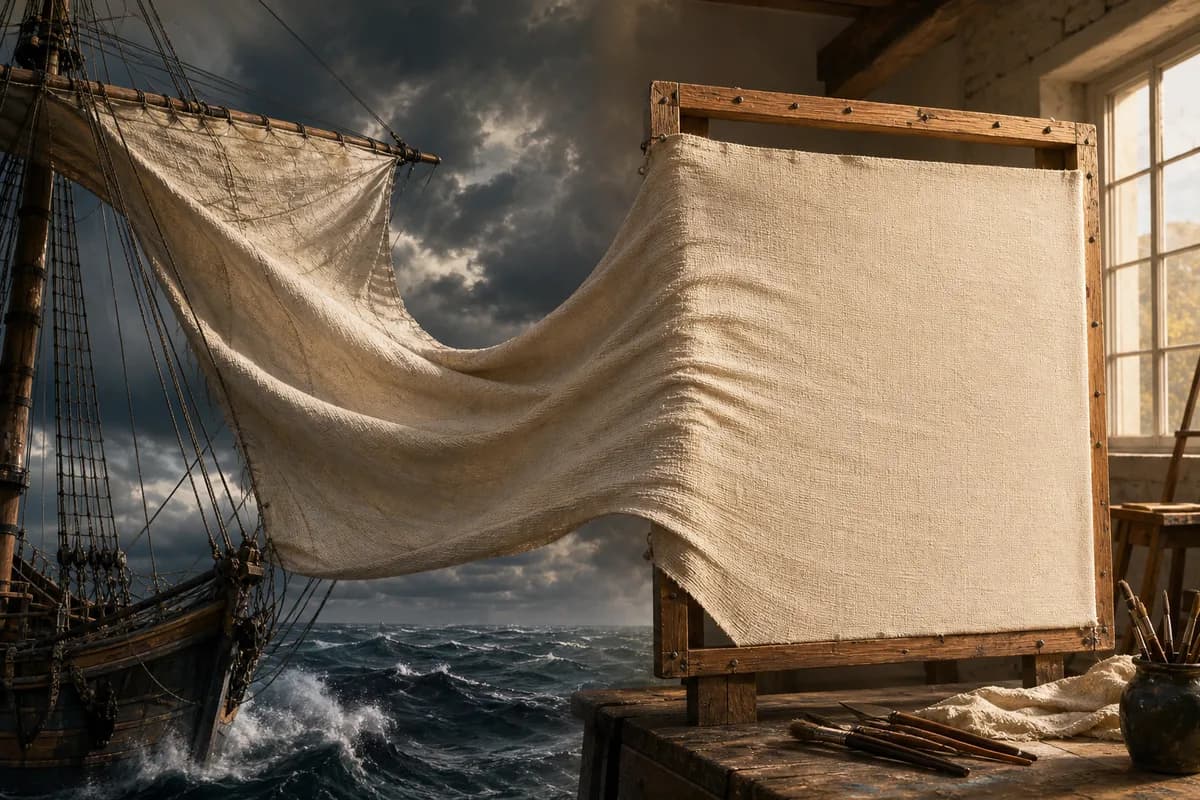
Tudor England treated hemp as strategic material. Accounts of Britain's compulsory hemp-growing laws describe how Henry VIII required farmers with sufficient acreage to grow hemp or flax, and Elizabeth I renewed the pressure later in the century. The point was not bohemian self-expression. It was ships, ropes and survival in a country that expected naval conflict as a permanent condition.
Stretch sailcloth over a frame, prime it, and the age of canvas painting begins. The modern large-format canvas over your fireplace is cotton or poly-cotton now, but the name, the weave and the whole idea of art-on-stretched-cloth still carry that older logic. The cleanest, most respectable object in the room is materially descended from naval procurement and linguistically related to cannabis. Interior design does not usually lead with that on the moodboard.
Five Men Against the LED
The gas lamp was the horse's contemporary and shared its obituary. Gaslight arrived in the early nineteenth century, gave the Victorian city its warm orange night, and then was declared obsolete by electricity. It should be long gone.
It is not. London still keeps a small population of working gas lamps, and the best accounts of them sound less like infrastructure reporting than folklore. The Londoner's reporting on the remaining lamps describes the city's handful of lamplighters, while Historic England's Westminster gas lamp listing records protection for lamps that campaigners fought to save from LED conversion.
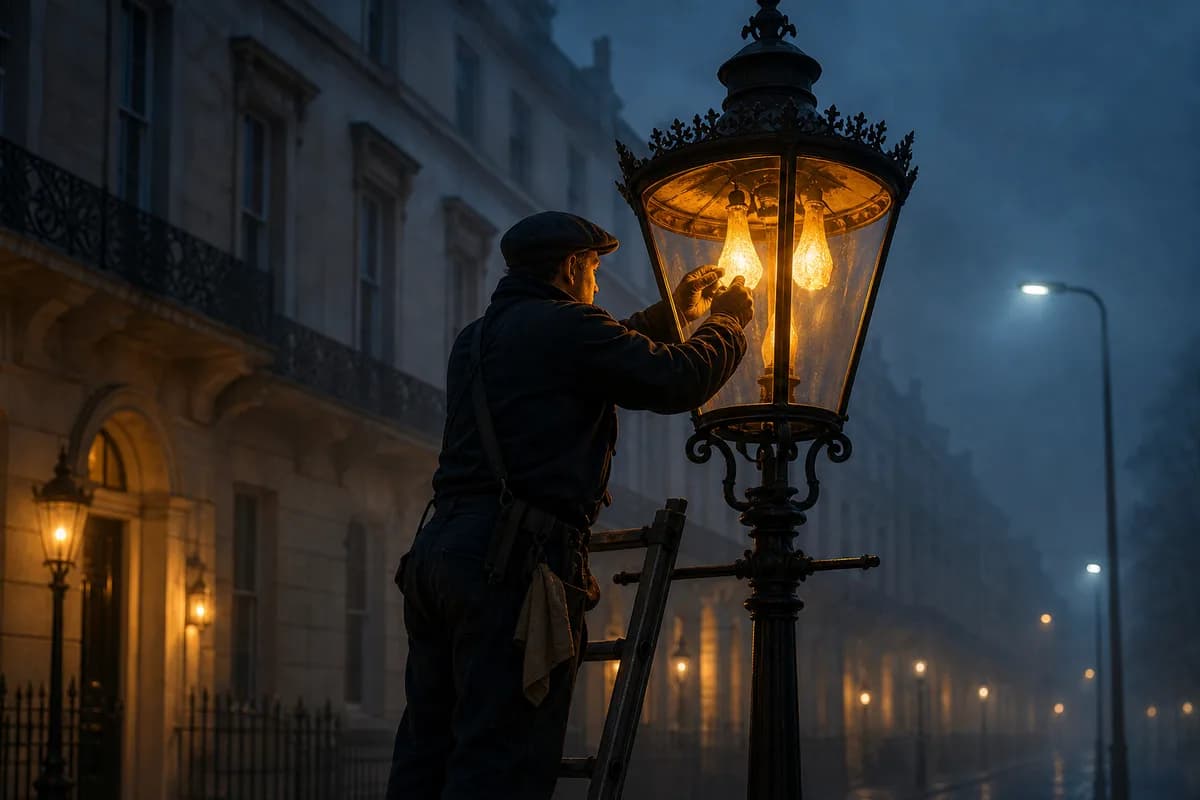
The sensible plan was obvious: replace inefficient gas with replica LEDs, keep the silhouette and reduce the maintenance headache. The public objected because they were not defending gas as fuel. They were defending atmosphere, the exact warm, low, human light that efficient planning had spent a century scrubbing out street by street.
We have made a version of this argument before, about why Canaletto's Thames and the Shard's skyline are really one long disagreement about what London should look like. The gas lamps are that disagreement at street level, one post at a time. And it is the same instinct, scaled down once more, that decides what goes on a living-room wall: rationally, a blank wall costs nothing and offends no one. But it also says something you may not mean to say.
The same fight over atmosphere runs through raw concrete, Berlin interiors and exposed-brick branding in The Honesty Racket. The nostalgia version of that fight, where impractical atmosphere wins because everyone admits it is impractical and loves it anyway, continues in The Editing Suite.
The Technocrats Would Like a Word
If the pattern so far is confident experts and wrong futures, it is worth meeting the most confident of them all. In Depression-era America, Howard Scott and Technocracy Incorporated built a movement around a beautifully simple idea: politics had failed, so engineers should run everything.
The movement imagined a society administered by technical experts, with money replaced by energy certificates linked to production and consumption. Encyclopedia.com's account of the Technocracy movement captures the appeal and the period setting: economic collapse had made political argument feel exhausted, and machines appeared to offer a cleaner authority.
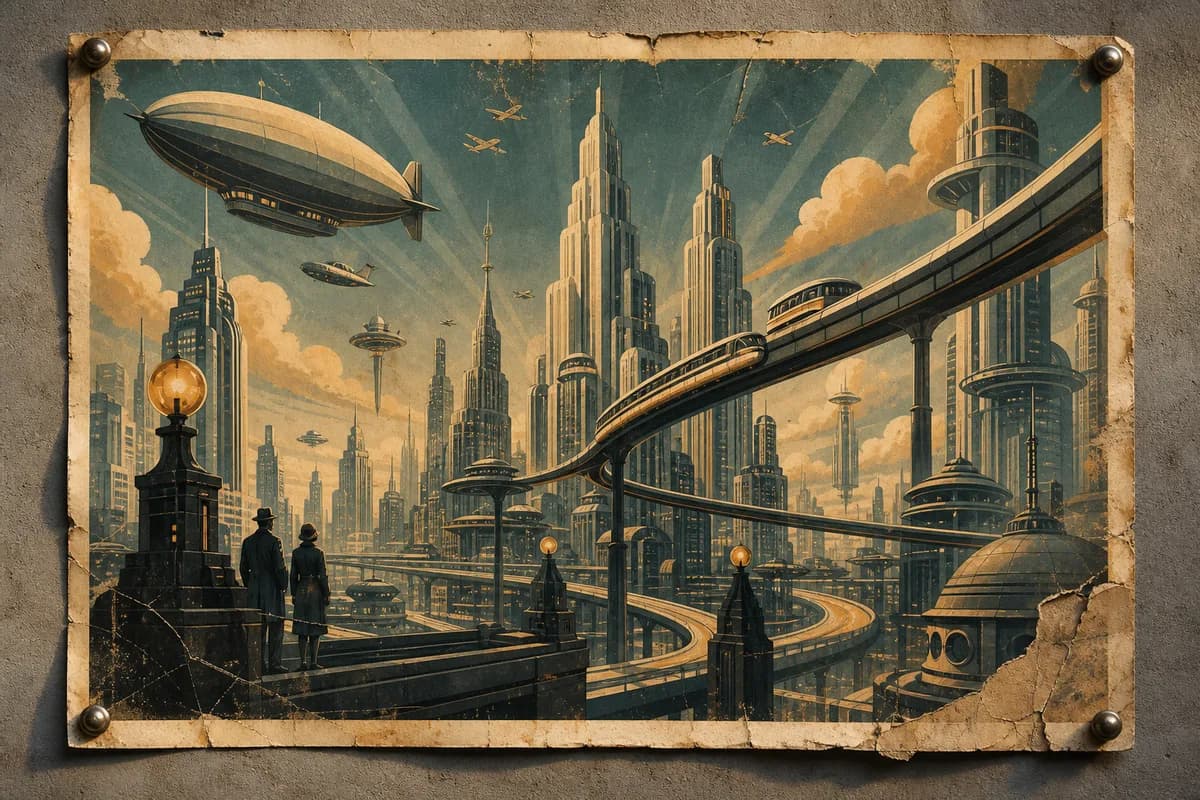
The strange thing is not that Technocracy Inc. faded. Most movements fade. The strange thing is how familiar the promise sounds now: the algorithm will allocate better than the voter, the system will know what people need, and the machines are about to change the city into something cleaner, smarter and more obedient than the one we actually live in.
Which makes the present moment worth looking at through the same lens. Manna, an Irish drone-delivery company, made the future wonderfully literal by flying coffee and groceries over Dublin suburbs. The Guardian reported in 2025 on drone coffee over Dublin and the company's rapid delivery model; by July 2026, The Times reported that Manna had paused domestic operations while reassessing the business. The future arrived, hovered, delivered coffee and then became operationally complicated.
That does not make the technology fake. It makes it urban. Some of it happens sideways. Some of it pauses. Some of it becomes normal. Most of it fails to replace the old thing as completely as the render promised. The sky gets drones; the ground keeps ponies; the drink is still coffee; and somewhere between them, the actual city carries on ignoring the concept art.
A Museum of Retired Futures
Which brings us to the small test promised at the start: look at your own walls. There is a decent chance that what hangs there, or what you have been meaning to hang there, is retired infrastructure.
Horses were transport. Star charts and celestial maps were navigation before they were decor, which is why Zellart's astronomy and space wall art and the Milky Way Stars canvas print sell feeling rather than function. Maps once got people across land and sea; we have argued elsewhere that they became Britain's most quietly beloved art form partly because nobody needs them in the same way anymore.
This is not nostalgia, or not only nostalgia. It is the same verdict the public has returned in every case above: against the confident forecast and in favour of the thing that outlived it. The coffeehouse over the royal proclamation. The lamp over the retrofit. The pony over the planning committee. Its louder sibling, where authority tries to suppress art and the public queues for it anyway, is the story in our history of art behaving badly. What a room keeps, and what the feed tries to flatten, is the next argument in The Beige International.
A wall, in the end, is where the city's retired futures go to be loved full-time. Choose accordingly: from horses, star fields, maps or large stretched canvases. Whatever the experts are predicting this week, the manure never came.
Zellart editorial
Read more
Three related Zellart essays to keep the thread going.

Art & Design
The Beige International
How Airbnb, staging and ecommerce taught rooms to look the same, and why walls still need to argue for someone.
Read article
Interior Design
What Hotel Lobbies Know About Art
What hotel lobbies understand about scale, mood, local reference and first impressions.
Read article
Art & Design
The Room That Stares Back
A case for dark, human maximalism through AI images, deep-ocean life, Medusa, protest graphics and Tokyo vintage.
Read article