
Bare Wall Sociology
What a Room Without Art Says About Its Owner: The Sociology of the Bare Wall
What does a room without art actually say?
A room without art rarely says one thing. It usually says one of three things: deliberate minimalism, temporary occupancy, or deferred self-definition. A bare wall can be an aesthetic decision, a rental survival tactic, or a quiet sign that the owner has not yet decided what kind of person the room should reflect.
The difference is intention. A minimalist bare wall feels edited. A transient bare wall feels provisional. An avoidant bare wall feels unfinished. Environmental psychology research treats home personalisation as a way people express identity through interiors; one study asked 107 women to assess bedroom images and found that observers inferred characteristics from those rooms.[1]
In England, the same question is tied to housing stability. Government data shows that 20% of private renters had lived in their current home for less than one year, compared with 4% of owner occupiers.[2] The first piece you commit to is often the threshold moment - sometimes a bestseller wall art choice that signals "I live here now."

Why is a blank wall not really blank?
A blank wall is not neutral because domestic space is read socially. People use rooms to communicate stability, taste, class, memory, restraint, aspiration and belonging. Even the refusal to decorate becomes part of the message.
| Bare wall type | What it usually means | What gives it away |
|---|---|---|
| Chosen absence | Minimalism, restraint, visual discipline | The room is otherwise finished, balanced, clean and intentional |
| Forced absence | Renting, moving soon, deposit anxiety, limited budget | Temporary furniture, unopened boxes, removable strips, no permanent fixtures |
| Deferred presence | Avoidance, indecision, fear of choosing the wrong identity | The room is mostly complete, but the walls remain unresolved |
The sociology of the bare wall begins with a simple idea: walls are where private life becomes visible. Floors and sofas are functional; walls are declarative. A sofa says someone sits here. A painting says someone has chosen what should be looked at.
When are bare walls minimalism rather than neglect?
Bare walls signal minimalism when the absence looks curated, not accidental. Minimalism is not the same as having nothing; it is the deliberate editing of visual noise so that a room feels controlled, calm and complete.
This distinction has a long history. Britannica describes 12th-century Cistercian churches as exceedingly plain and unadorned by figural or decorative sculpture.[3] That older ascetic tradition still echoes in modern minimalism. Bloomsbury frames Kyle Chayka's The Longing for Less as a search for presence rather than absence, while Chayka has criticised the newer style of total blankness as a narrow orthodoxy.[4][10]
- The room contains fewer objects, but the remaining objects are high-intention.
- The empty wall is balanced by texture, light, architecture or one strong focal point.
- Nothing feels postponed; the emptiness feels finished.
- The room has a clear philosophy: calm, order, restraint, silence.
Minimalism becomes convincing when the wall is empty because something was removed, not because nothing was ever chosen.
What is the history of the bare wall?
- 1
Monastic restraint
Plainness as discipline.
- 2
Modernist reduction
Function, line and visual clarity.
- 3
KonMari decluttering
Choosing what supports the life you want.
- 4
Instagram minimalism
A recognisable aesthetic of curated less.
- 5
Warm minimalism
Texture and restraint without emptiness.
The blank wall has moved through several meanings: spiritual discipline, moral restraint, modernist clarity, lifestyle optimisation and psychological self-editing. What changed is not the wall itself, but the reason people leave it empty.
| Period or movement | What the bare wall meant | How it still appears today |
|---|---|---|
| Monastic asceticism | Refusal of distraction, ornament and worldly display | Quiet rooms, simple materials, limited decoration |
| Cistercian architecture | Plainness as religious and architectural discipline | Severe interiors where proportion matters more than ornament |
| Modernism | Reduction, function and visual clarity | White walls, clean lines, furniture as structure |
| Marie Kondo / KonMari | Keeping only what supports the life you want | Decluttered homes where every object must justify itself |
| Contemporary minimalism | Control, taste, wellness and sometimes status | Empty walls, neutral palettes and curated less |
Marie Kondo's official KonMari framing is not simply about throwing things away. It starts by imagining an ideal lifestyle and using joy as a standard for what remains.[5] That is why the bare wall became morally complicated. A white wall can mean peace. It can also mean fear of commitment disguised as taste.
When do bare walls signal transience?
Bare walls signal transience when the room looks inhabited but not settled. In that case, the empty wall does not mean "I prefer less"; it means "I may not be here long enough to choose more."
The latest English Housing Survey headline release reported that owner occupation remained the largest tenure group in England at 65% of households, followed by the private rented sector at 19% and social renting at 16%. It also found satisfaction with accommodation was 94% among owner occupiers and 81% among private renters.[6]
Mobility changes decoration. A tenant may avoid drilling, framing, repainting or buying large pieces because every decorative act creates a future problem: repair the wall, negotiate with the landlord, move the object, or accept that the home is temporary.
- "I do not want to lose my deposit."
- "I might move before this becomes worth doing."
- "This is a stopover, not a statement."
- "I live here, but I have not fully arrived."
The sociology here is sharp: ownership makes walls feel available; insecurity makes walls feel borrowed.
When are bare walls a form of avoidance?
Bare walls become avoidance when the person wants the room to feel finished but keeps delaying the decision. In that case, the blank wall is not an aesthetic position; it is a postponed act of self-definition.
Psychology helps explain why. Iyengar and Lepper's choice-overload research found that people were more likely to buy when offered a limited set of six options than when offered larger sets of 24 or 30.[7] The bare wall is a perfect choice overload problem. There are too many sizes, subjects, colours, frames, moods, styles and meanings.
Status quo bias adds another layer. Wharton has discussed the inertia behind status quo bias: when people already have something, it can feel harder to give it up than to acquire something new.[8] Blankness is easy to defend because it cannot clash, be judged or reveal a taste that later feels embarrassing.
The avoidant bare wall often appears in otherwise finished rooms: the sofa is chosen, the rug is chosen, the lighting is chosen, but the wall still waits. That is the clue. The person has decorated around identity, not through it.
Why does the first artwork feel more important?
The first artwork feels important because it changes the home from a neutral container into a self-descriptive space. It is often the first decorative object that is both visible to others and emotionally chosen by the owner.
Research on home personalisation supports this. A mixed-method study used a survey of 101 participants and interviews with 13 participants, and found a direct link between residents' involvement in transforming their home and satisfaction with residence and life.[9]
That is why the first artwork is rarely just "something for the wall." It decides the room's emotional accent. It says whether the home wants to feel calm, clever, coastal, urban, romantic, dramatic, restrained, nostalgic or ambitious.
The first piece you commit to is the threshold moment - often a bestseller wall art choice that signals "I live here now," which is why that first purchase carries outsized psychological weight.
| Question to ask | Minimalism | Transience | Avoidance |
|---|---|---|---|
| Does the room feel finished? | Yes | Not fully | Almost, except the wall |
| Is the emptiness aesthetic? | Yes | Not mainly | Not convincingly |
| Is there evidence of future movement? | Usually no | Yes | Sometimes |
| Are other objects carefully chosen? | Yes | Mixed or temporary | Yes |
| Does the wall feel peaceful or tense? | Peaceful | Practical | Tense |
| What is the likely message? | "I have edited this room." | "I may not stay." | "I have not decided who this room is." |
This is not a personality diagnosis. A bare wall may also reflect money, time, grief, neurodivergence, depression, renovation delays, cultural preference, landlord rules or simple exhaustion. The point is not to shame the empty wall. The point is to notice that blankness has social meaning.
edited
One deliberate empty plane, balanced by texture and light.
borrowed
Temporary furniture, moving boxes and removable fixings.
undecided
A finished room with one unresolved wall still waiting.
What does a room without art say in a British home?
In a British home, a room without art often sits between taste and tenancy. UK homes are shaped by smaller rooms, rental restrictions, moving costs, older housing stock and a culture that often treats visible self-expression as something to be done carefully rather than loudly.
The same bare wall reads differently in a London rental, a Manchester first flat, a Cotswolds cottage, a student house in Bristol, or a long-owned family home in Surrey. In a short-term rental, blankness can be rational. In a settled home, persistent blankness becomes more expressive.
British interiors often rely on walls to create warmth. When the weather is grey, daylight is limited and rooms are compact, wall art does more than decorate. It gives the room a point of orientation. It can add colour without repainting, scale without buying more furniture and identity without clutter.
- It gives a neutral room a focal point.
- It adds colour without permanent renovation.
- It makes a rental feel lived-in without major damage.
- It anchors a sofa, bed, dining table, hallway or home office.
- It lets the owner express taste without filling the room with objects.
What should the first artwork actually do?
The first artwork should make the room feel claimed. It does not need to explain the owner's entire personality, but it should give the space a stable emotional direction.
| First artwork type | What it does socially | Why it works as a first choice |
|---|---|---|
| Abstract wall art | Signals taste without revealing too much biography | Flexible, grown-up, works with many interiors |
| Black and white wall art | Signals control, restraint and urbanity | Easy to pair with neutral UK interiors |
| Botanical wall art | Signals softness, care and domestic warmth | Adds life without visual chaos |
| Coastal wall art | Signals calm, memory, escape and British seaside feeling | Works especially well in bedrooms and relaxed living rooms |
| Large canvas wall art | Signals permanence and confidence | One decisive piece can finish a whole room |
The safest first artwork is not always the blandest one. It is the piece that gives the room a direction without trapping the owner in a theme.
People judge bare walls quickly because rooms are read as biographies. A home is one of the few places where private identity becomes visible through repeated choices: what is kept, displayed, hidden, repaired, framed, inherited or left empty. The Psicothema bedroom study is useful here because it shows that observers infer characteristics from interior images, even though they are only seeing a room.[1]
A bare wall is better than art that fights the room or misrepresents the owner. The mistake is not emptiness; the mistake is accidental emptiness pretending to be a philosophy.
The bare wall is a theory of the self
Every undecorated wall proposes an answer to the same question: how visible do I want my inner life to be? Minimalism answers, "Only the essential parts." Transience answers, "Not here, not yet." Avoidance answers, "I do not know how to choose." Home-making answers, "This is where I begin to appear."
The hook in the wall is tiny. The commitment is not.
Choose the first piece by deciding what emotional job the room needs to do. Do not start with "What art do I like?" Start with "What should this room help me feel?"
| Room need | Better first artwork direction | Why it works |
|---|---|---|
| The room feels cold | Botanical, warm abstract, soft landscape | Adds life and warmth |
| The room feels chaotic | Black and white, minimalist abstract | Creates order |
| The room feels temporary | Large canvas, framed-looking composition, central focal point | Signals permanence |
| The room feels dull | Colour-field abstract, coastal, floral | Adds energy without clutter |
| The room feels impersonal | Travel, cityscape, nature, meaningful subject | Adds biography |
A first artwork does not need to be perfect forever. It only needs to be honest enough to begin. Once one piece is chosen, the room becomes easier to finish because the first decision narrows the next decisions.
The same instinct sits behind Zellart's art-history long read Trouble on the Wall: rebellious art usually begins as a refusal of permission, then ends up becoming the image people want to live with.
Explore first-piece wall art
Popular canvas prints chosen for living rooms, bedrooms, rentals and first homes.
FAQ
Does having no art mean someone has no personality?
No. Having no art does not mean someone has no personality. It usually means one of four things: they prefer restraint, they are living temporarily, they are avoiding a difficult choice, or they have practical constraints. A bare wall is a clue about home-making, not a complete judgement of character.
Is a bare wall minimalist?
A bare wall is minimalist only when the room around it feels intentionally edited. If the furniture, lighting, materials, and proportions are resolved, the empty wall may be part of the design. If the room feels unfinished, the bare wall is more likely to signal delay, transience, or indecision.
Why do renters often leave walls bare?
Renters often leave walls bare because decorating can feel risky or temporary. In England, 20% of private renters had lived in their current home for less than one year in 2023-24, far higher than owner occupiers at 4%. Short stays make permanent decoration feel less worthwhile.
Why does buying the first piece of wall art feel difficult?
Buying the first piece of wall art feels difficult because it is a visible identity choice. Wall art involves many options: style, size, colour, subject, mood, and meaning. Too many options can make the first decision feel heavier than it really is.
What is the safest first wall art choice?
The safest first wall art choice is usually a piece that gives the room a mood without making the whole space feel themed. Abstract, black and white, botanical, coastal, and large canvas prints work well because they can anchor a room while leaving future styling flexible.
Can one artwork make a room feel like home?
Yes, one artwork can make a room feel more like home because it creates a focal point and introduces personal choice. Research on home personalisation links residents' involvement in transforming a home with satisfaction in both residence and life.
What does a blank wall say in a UK home?
In a UK home, a blank wall often says either "I like restraint," "I rent," "I may move," or "I have not decided yet." Because many UK homes are compact or rented, bare walls often reflect practical constraints as much as personal taste.
Sources
- [1] Aragones, Amerigo and Perez-Lopez, Perception of personal identity at home
- [2] GOV.UK, English Housing Survey 2023-24: rented sectors
- [3] Britannica, Cistercian style
- [4] Bloomsbury, The Longing for Less
- [5] KonMari, Imagine Your Ideal Lifestyle
- [6] GOV.UK, English Housing Survey 2024 to 2025 headline findings
- [7] Columbia Business School, When choice is demotivating
- [8] Knowledge at Wharton, behavioural economics and inertia
- [9] Tarazi, Redford and Rice, role of personalisation of homes
- [10] Vanity Fair, interview with Kyle Chayka on minimalism
Zellart editorial
Read more
Three related Zellart essays to keep the thread going.

Art & Design
The Beige International
How Airbnb, staging and ecommerce taught rooms to look the same, and why walls still need to argue for someone.
Read article
Art & Design
The Room That Stares Back
A case for dark, human maximalism through AI images, deep-ocean life, Medusa, protest graphics and Tokyo vintage.
Read article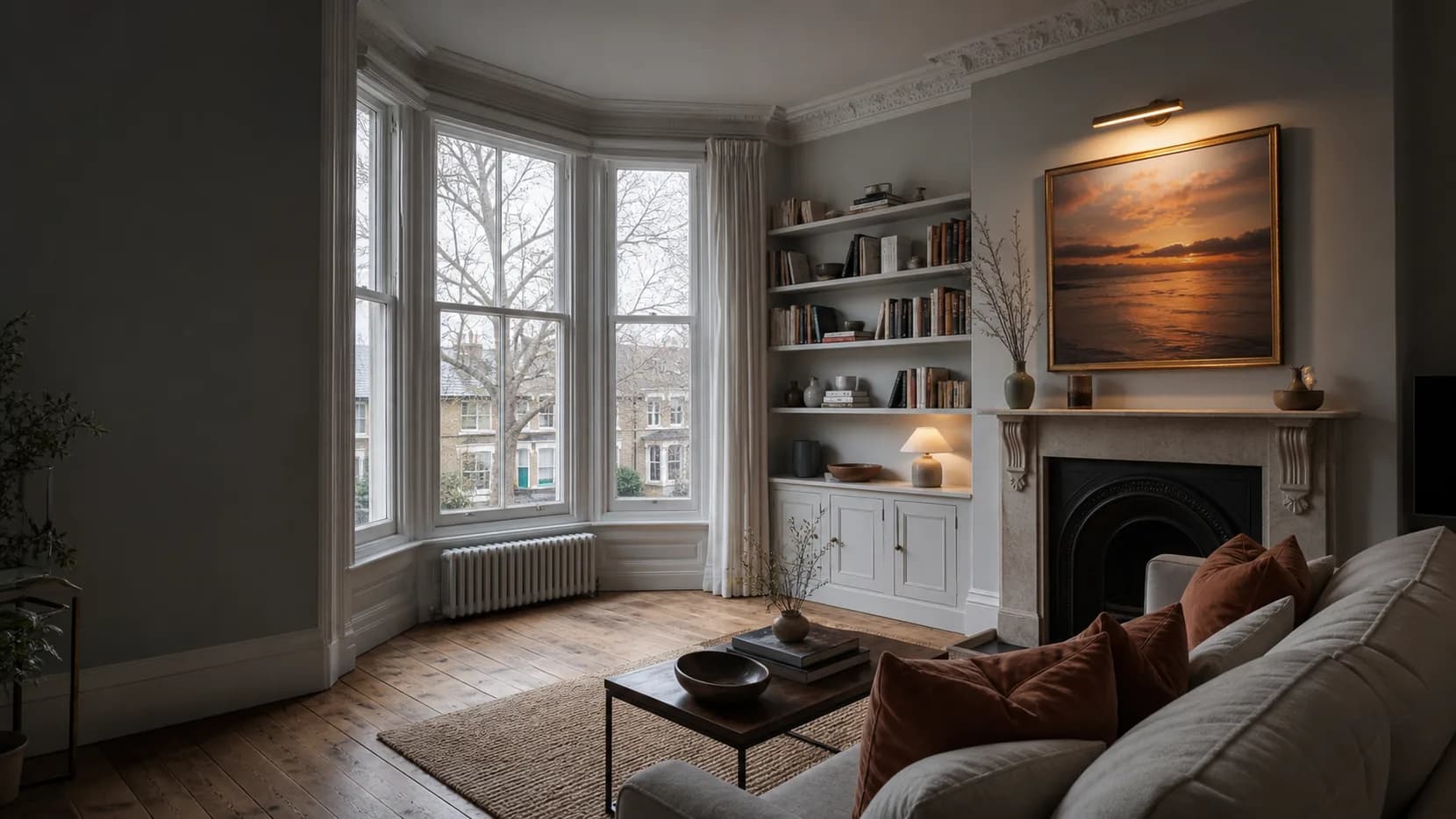
Wall Art
Painting for Grey
A practical guide to choosing warm, steady art for north-facing British rooms and winter light.
Read article