

Every home has one wall that has not quite decided what kind of person lives there yet. You know the one. It has had a mirror on it, then nothing, then a shelf you took down because it looked like a dentist's waiting room. That wall is not a design problem. It is a small, ongoing argument about taste, and taste, properly understood, has never once in recorded art history been polite.
Here is the theory this piece is going to try to sell you: rebellion is not a footnote in art history. It is the business model. Every generation produces an establishment that declares some picture, some artist, some idea too much, and every generation's public then turns up in bigger numbers to see the "too much" than the approved alternative. This has been true in Vienna, Munich, Beijing, Brooklyn and London. It will probably still be true next year, which is a more useful prediction than anything Nostradamus has managed lately, and we will get to that.
The Ceiling Nobody Was Allowed to Love
Start in Vienna, 1897. A group of young Austrian artists, unhappy with the state-approved academic art of the day, walked out and formed their own club. They called it the Vienna Secession. At the entrance to their exhibitions, visitors met the motto "To every age its art, to every art its freedom," according to MoMA. That line is either a manifesto or a threat, depending on how comfortable you were in the old academy.
Gustav Klimt was their first president. The National Gallery describes him as one of the founders of the Secession, and his early success was conventional enough to make the later scandal more useful. The University of Vienna commissioned him to paint three ceiling panels for its Great Hall: Philosophy, Medicine and Jurisprudence. What he delivered was not tidy allegorical furniture. It was crowded, sensual, unresolved and extremely inconvenient.
The university rejected the paintings. The works did not simply lose a committee vote; they damaged Klimt's relationship with public approval so thoroughly that he never again accepted a public commission. What happened next is the part everyone forgets: he did not quiet down. He became richer, stranger and visually harder to domesticate.
That is the first useful lesson for a wall at home. Taste is often presented as a settled code: this is refined, this is too much, this belongs in a grown-up room, this does not. But the code changes after the risk has already been taken. The difference between a scandalous image and a classic image is sometimes only time, money and enough people deciding they were comfortable with it after all.
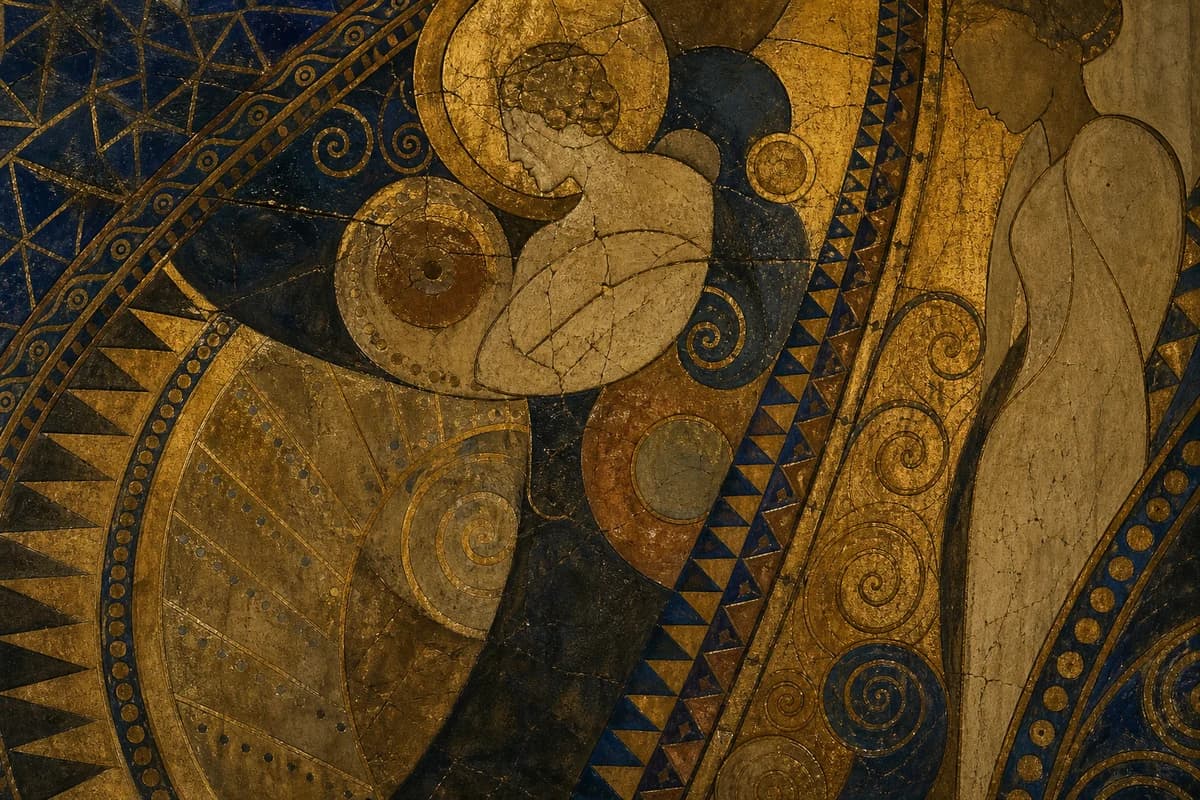
Cut loose from official approval, Klimt moved into what is now called his golden phase: gold leaf, Byzantine flatness, ornamental pattern and the kind of luminous intimacy that eventually turned into museum-shop shorthand. In 2006, Ronald Lauder bought Portrait of Adele Bloch-Bauer I for $135 million, according to Christie's. The same broad culture that once found Klimt's university paintings unbearable later found his gold irresistible. Scandal, it turns out, has a shelf life of about a century, after which it becomes merchandise.
This is why Klimt is more interesting than the usual artist-misunderstood-by-critics story. He was not misunderstood into silence. The refusal of official approval changed where the work had to live. It moved from civic ceiling to private collector, from public instruction to private appetite. Domestic walls have always been part of the afterlife of difficult art: the academy rejects, the collector buys, the museum canonises, and then a hundred years later someone discovers that the image looks alarmingly good above a velvet sofa.
If you want a taste of that golden period on your own wall without waiting for a museum to lend you $135 million, Zellart's Painterly Blue and Gold Figures canvas print sits in the same emotional neighbourhood: rich blue, gold ornament, a figure that is not explaining itself to you. It will not get you banned from a university. It might get you asked about it at dinner, which is the modern, lower-stakes version of the same thing.
Vienna Looked East, and Nobody Much Noticed Until Later
Here is a detail that tends to get cut from the Klimt story because it does not fit the tortured Viennese genius narrative neatly: his decorative logic was not sealed inside Vienna. Japanese ukiyo-e woodblock prints had poured into European visual culture in the late nineteenth century, and Klimt's flat space, patterned surfaces and refusal of traditional depth belong to that larger exchange.
That exchange is easy to romanticise now because the results are beautiful. At the time, it also challenged hierarchy. European academic painting had spent a long time treating depth, modelling and classical proportion as proof of seriousness. Ukiyo-e did not ask permission from that system. Its flatness, cropping and pattern could make a European canvas feel newly unstable, as if the room itself had been rearranged.
That matters because rebellion often arrives disguised as foreign influence, decorative fashion or someone else's visual grammar. The scandal is not always a smashed object. Sometimes it is a new way of arranging space so confidently that the old way suddenly looks provincial.
Influence can be a form of pressure. Once a different visual system proves it can carry beauty, mood and authority, the supposedly universal rules of the old system start to look local. That is dangerous to every academy, because academies depend on confusing local habit with permanent truth.

Ninety-eight years later, on the other side of the world, an artist would make a related argument with considerably less subtlety and no canvas at all. Klimt smuggled a different visual logic into academic painting. Ai Weiwei made the question literal: what happens if the old object hits the floor?
Beijing, 1995: Some Rebellions Come With a Sound Effect
In 1995, Ai Weiwei picked up a 2,000-year-old Han dynasty urn and dropped it. The work, Dropping a Han Dynasty Urn, is a three-frame photographic sequence: holding, falling, shattered. The Guggenheim Bilbao describes the photographs as a moment when tradition is challenged by new values, and that is almost too calm a sentence for the noise it implies.
Ai's point was not that old things are worthless. It was that value is assigned, defended and policed by people. Smarthistory notes that the work is both photography and performance, and that it forces viewers to consider transformation and destruction of the past. That is why the argument has never really ended. If the urn was valuable because a culture decided it was valuable, could an artist use its destruction to expose the rules of that decision?
The discomfort is the work. If the urn had been a plaster prop, the gesture would have been theatre. If it had been protected in a museum case, it would have remained heritage. By choosing an object that viewers understood as old, real and culturally loaded, Ai forced the audience to decide whether it cared more about the object or the system that taught it to care.
This is where the comparison with Klimt becomes sharper. Klimt broke a visual rule and lost institutional favour. Ai broke an object and gained a different kind of historical charge. In both cases the artwork does not sit quietly inside the category assigned to it. It tests the category until the category looks foolish.
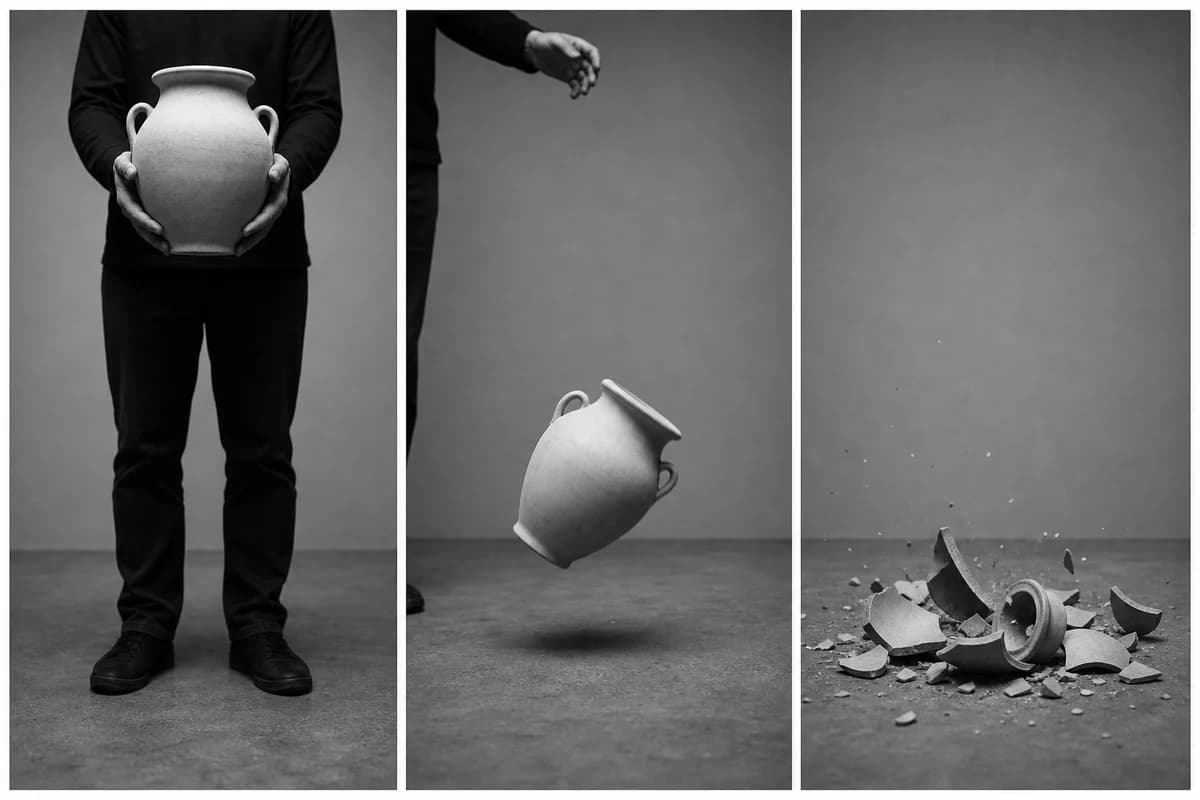
Two rebellions, nearly a century and one continent apart: Klimt importing foreign visual logic into a closed academic system, Ai smashing an inherited object to make a point about who gets to decide its worth. Different tools, same argument. The old guard does not get the final say on value.
War, and the Regimes That Tried to Legislate Taste
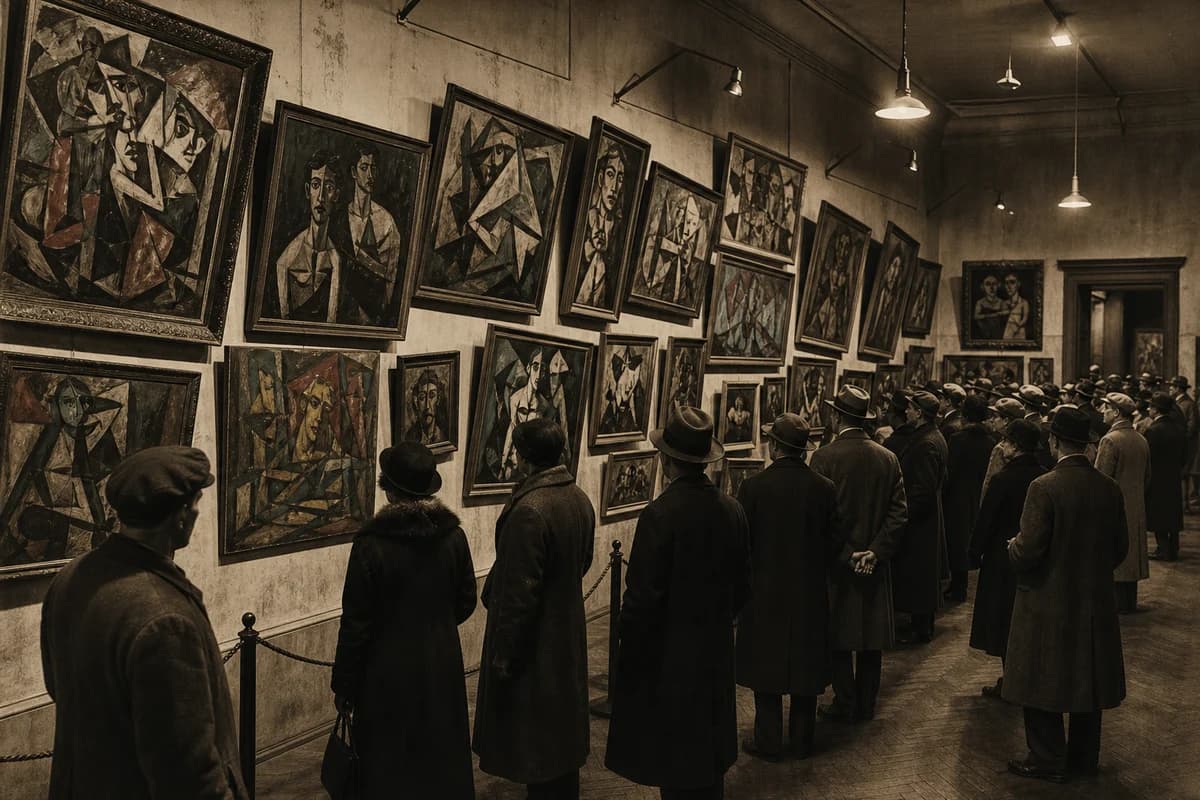
Now the part that is not funny at all, because this is where Klimt's ceiling panels come back into the story. In 1937, the Nazi regime staged an exhibition in Munich called Entartete Kunst, or Degenerate Art. The United States Holocaust Memorial Museum records that more than 2 million people passed through the cramped exhibition in 1937, while the approved Great German Art Exhibition nearby attracted fewer than 500,000 visitors.
That number should be on a poster. The regime built a monument to bad taste specifically to humiliate the art it hated, and the public queued around the block for the humiliation. You cannot manufacture that kind of curiosity. You can only, it seems, try to ban it into existence.
The display strategy was supposed to do the argument for the regime. Works were crowded, mocked and made to look unstable. That is the strange weakness of cultural censorship: it often has to show people the thing it wants them not to want. The exhibition was meant to teach disgust, but it also created access. It gathered the forbidden images in one place, gave them a name and turned disapproval into a route map.
The story did not end with humiliation. In March 1939, the Propaganda Ministry had around 5,000 artworks burned in the courtyard of Berlin's main fire department, according to the Victoria and Albert Museum's Entartete Kunst inventory. And in May 1945, the Immendorf fire destroyed the stored Klimt Faculty Paintings. What is left of those rejected university works is evidence, memory and photographs. The paint itself is gone.
"Two million people queued to see the art their government told them to hate. Fewer than half a million turned up for the art they were told to admire.
There is a version of this piece that stops here and calls it a grim irony. It is more than irony. It is the plainest evidence available that trying to legislate what people are allowed to find beautiful tends to produce the opposite of the intended result, at a cost measured in objects that can never be replaced.
That cost is the part domestic design language tends to smooth over. We like to talk about bold art, daring walls and statement pieces, as if difficulty is only a styling flavour. But the history behind difficult art includes institutions with real power, artists with real danger around them and works that did not survive long enough to become safe. The wall at home is not the battlefield. It is the quiet afterlife, the place where a once-dangerous visual language can finally be lived with.
Architecture ran the same test in another language: when honesty became a design principle, flat roofs and raw concrete acquired political enemies. That later story is The Honesty Racket.
London, This Spring: Same Instinct, Better PR
Which brings us, gently, to Banksy. On 30 April 2026, a new statue appeared on Waterloo Place in central London: a suited figure stepping from a plinth while a flag wraps back across his face. The Art Newspaper reported that Banksy later confirmed the work through Instagram, and The Guardian reported its position among central London monuments to Edward VII and Florence Nightingale.
The official reaction was almost funnier than the object. Westminster City Council put barriers around it and described it as a striking addition to public art. That is not how Banksy works are always treated. In September 2025, a Banksy mural at the Royal Courts of Justice showed a judge striking a protester; PBS NewsHour and AP reported that the court service said it would remove the mural because the building was listed.
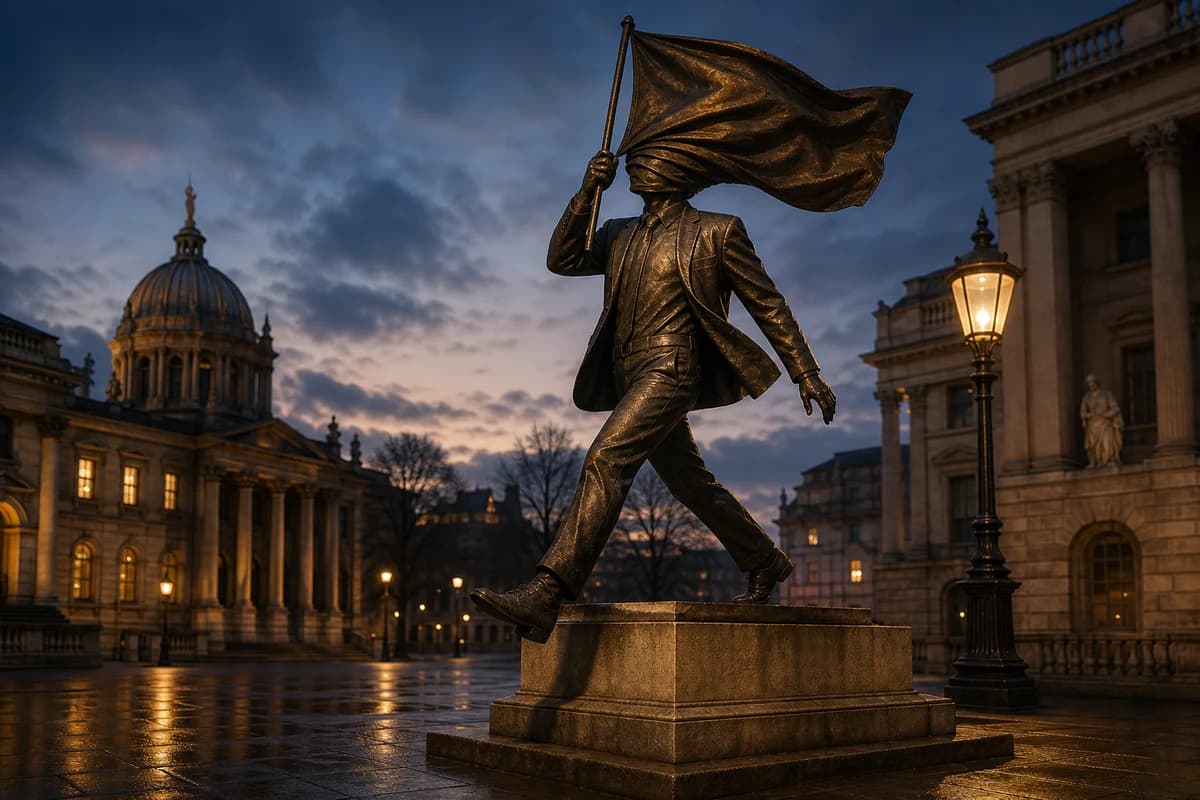
Two very different outcomes for two pieces by the same anonymous artist, decided by which institution felt implicated. A statue that mocks blind patriotism gets barriers and a welcome statement. A mural that mocks the judiciary gets removed. Munich, 1937, minus the bonfire, with better lighting.
That does not make Banksy equivalent to the artists persecuted by dictatorships, and the comparison should not be flattened. What it does show is the same social reflex at a safer scale. Institutions often become generous toward rebellion once the target is someone else. They become much less generous when the work points back at them. Public art is not only about the public. It is also about who gets embarrassed in public.
We have written before about how contested London's own skyline is as a subject,from Canaletto's calm, ordered Thames to the Shard's vertical argument. Banksy's Waterloo Place statue is standing, almost too neatly, among monuments to public virtue and national memory. If that tension is something you want on your own wall rather than just in the news, Zellart's black-and-white wall art collection leans into the same high-contrast boldness. The graphic Black and White Tiger Face print has that blunt stencil-adjacent force without needing a council permit.
For the city itself, arguments included, the London cityscape collection keeps the skyline in play. The Tower Bridge print is a calmer London than Banksy's, but it still belongs to the same city that keeps renegotiating what public space is supposed to look like.
That is why graphic, high-contrast art works so well in modern rooms. It carries a trace of the poster, the stencil and the protest placard, even when the subject is not political. The eye reads black and white quickly. It feels decisive. In a room full of soft textiles, rounded furniture and polite neutrals, one severe image can do what a dozen accessories cannot: it gives the room a point of view.
The domestic return of that pressure is part of why protest graphics have returned to domestic walls as one part of a wider appetite for rooms with visible evidence of a life.
Brooklyn, 2005: The Quiet Rebellion of Just Buying What You Like
Every rebellion so far has needed an establishment to fight: a university, a regime, a council. Here is a quieter one, with no bonfire and no barriers, that changed a similar amount. Etsy was founded in 2005, and Etsy Investor Relations now says the marketplace has more than 100 million items for sale, about 5.6 million active sellers and about 86.5 million active buyers as of 31 December 2025.

No jury decided all those things were worth making. The buyer decided. That is a smaller, friendlier version of the same argument Klimt, Ai Weiwei and Banksy made in louder ways: the institutions historically allowed to decide what counts as real art do not have a monopoly on that decision, and have not for a while.
This is not a romantic claim that every online listing is secretly a masterpiece. Most things are ordinary, and ordinary is part of the point. The rebellion is not that every object becomes high art. The rebellion is that gatekeeping loses its monopoly over circulation. A maker can find a buyer before a critic finds a sentence. A buyer can trust attraction before permission. The market becomes noisy, messy and sometimes absurd, but it also becomes harder for any single institution to decide what deserves to exist.
Every home that hangs something because it is loved rather than because a committee approved it is participating in the same small act of not waiting for permission. Zellart's abstract and watercolour collection exists for the same reason ukiyo-e ended up in Klimt's visual world: someone decided a different visual logic belonged in the room. If the exploratory instinct behind Klimt's Japanism is more your thing than gold leaf, it is the same impulse behind Britain's own long romance with maps and Zellart's world map prints. The quieter version of that question, what cities keep after experts announce the future, sits in our essay on horses, coffee, gaslight and failed urban predictions.
The home is where that permission question becomes intimate. Nobody needs a curator to justify why a map, wave, tiger, skyline or gold figure belongs above a console table. The room itself will decide whether the choice has conviction. That is a much more demanding test than it sounds, because you cannot hide behind cultural importance when the image has to live with your lamp, your sofa and the afternoon light.
A Word on Prophecy, Bees and Why Your Brain Keeps Doing This
Quick detour before we land the plane, because it explains something useful about all of the above. Nostradamus has become a reliable content machine for 2026. Sky HISTORY notes that Nostradamus did not explicitly date 2026, but that quatrains about a great swarm of bees, Ticino and celestial drama keep being attached to the year anyway.
The trick is not prophecy. It is confirmation bias: people assign meaning after they know how a story ends. That is also how culture often handles rebellious art. Klimt becomes obvious genius later. The Degenerate Art exhibition becomes a historical embarrassment later. Banksy's self-destructing auction prank looks cleverer after the paper finishes shredding. Nobody, not the professors, the regime, the court service or the auction house, predicts the story cleanly at the moment it happens.
This is the joke hidden inside every confident taste verdict. People talk as if they are predicting value, but they are often protecting comfort. A difficult image is rejected because it interrupts the present room, present institution or present social code. Later, when the interruption has been absorbed, the same image is described as inevitable. The future gets mistaken for taste.
So here is the prediction this piece can actually defend: whatever version of too much gets made this year, in Bristol, Beijing, Brooklyn, London or somewhere with worse lighting, a portion of it will still be on someone's wall in a hundred years, being sold as a museum print. That is a better hit rate than bees.
What Actually Goes on Your Wall
None of this is really an argument for owning a Klimt, a Banksy or a smashed urn. Most of us are not going to. It is an argument for what those things have in common with the wall behind your sofa: every one of them is a decision about which version of acceptable you are willing to ignore.
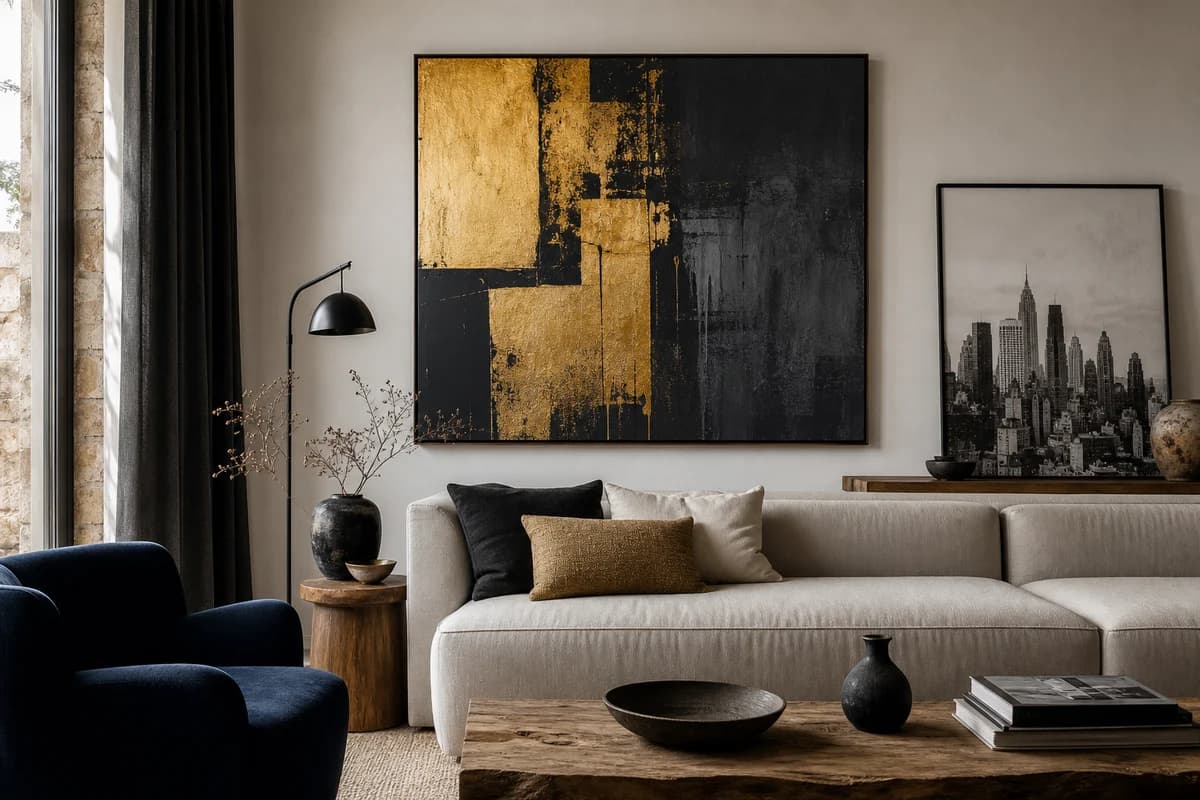
Choosing art for your own home is a lower-stakes version of the same decision, but it is still the same decision. It is why a bare wall says something whether you meant it to or not. Leaving it blank is not neutral; it is just a quieter kind of statement.
The useful question is not "Is this artwork rebellious enough?" That would be a very tedious way to buy a canvas. The useful question is whether the piece has enough conviction to change the room. Rebellion in a home can be small: choosing gold when the room expects beige, choosing black and white when the cushions want harmony, choosing a city skyline because the room needs an argument rather than another soft landscape. The point is not shock. The point is intent.
The same choice can also be flattened before you make it; that is the beige machine we unpack in The Beige International.
The gold-leaf instinct, the graphic stencil instinct, the "I want the argument in the room, not just the view" instinct - all of it is available now without a scandal attached. In rooms that need more scale, large-format wall art gives that decision enough presence to hold the wall. Nobody has to burn anything, ban anything or wait ninety-eight years for the culture to catch up. You just have to decide, the way Klimt's audience eventually did, that you liked it all along.
Zellart editorial
Read more
Three related Zellart essays to keep the thread going.

Art & Design
The Beige International
How Airbnb, staging and ecommerce taught rooms to look the same, and why walls still need to argue for someone.
Read article
Art & Design
The Room That Stares Back
A case for dark, human maximalism through AI images, deep-ocean life, Medusa, protest graphics and Tokyo vintage.
Read article
Interior Design
What a Room Without Art Says
A bare wall is not neutral. It says something about identity, renting, choice and domestic confidence.
Read article